Friday, October 27, 2006

The Bottled Water Lie


The Bottled Water Lie

By Michael Blanding, AlterNet. Posted October 26, 2006.

The corporations that sell bottled water are depleting natural resources, jacking up prices, and lying when they tell you their water is purer and tastes better than the stuff that comes out of the tap.

When Antonia Mahoney moved to Boston from her native Puerto Rico 35 years ago, the first thing she noticed was how much better the water tasted. Over the years, however, the water she was receiving from her tap began to lose its appeal. "Little by little, the taste changed," says the retired schoolteacher, who eventually gave up tap water altogether and began paying over $30 a month to get bottles of Poland Spring water delivered to her house.

Walking through Boston's Copley Square on a sunny day last month, however, she was intrigued by a banner advertising something called the "Tap Water Challenge." As she approached the table, a fresh-faced activist behind it told her the "challenge" was a blind taste test to see if passersby could tell the difference between bottled water and tap water. Mahoney turned her back while four water samples were poured into small paper cups -- two of tap water from Boston and a nearby suburb, and one each of Poland Spring and Aquafina.

"That's tap water," Mahoney declared after draining the first cup. "That tastes just like what I drink at home." Her confidence faded, however, as she downed the next three, which all seemed to taste the same. When the cups were turned over, it turned out that what she thought was tap water was actually Aquafina -- and what she thought was Poland Spring was actually the same Boston tap water she gets at home for free. "I couldn't believe it, I couldn't believe it," she says later. "You know I pay so much for that water. Now I am thinking to stop the Poland Spring."

Mahoney wasn't alone in that decision. A student from Connecticut who attends Massachusetts College of Art says that she has cartons of bottled water stocked in her dorm room, because she doesn't want to chance city tap water. After taking (and flunking) the test, she says now she'll start drinking from the faucet. "It tastes the same as the tap water I drink at home in Connecticut, and I drink that all the time," says the student, Katey vanBerkum. "Why spend your money on bottled water if you don't have to."

skip

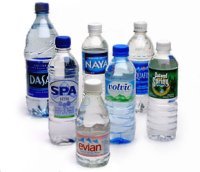
In the past decade, the bottled water market has more than doubled in the United States, surpassing juice, milk, and beer to become the second most popular beverage after soft drinks. According to a 2003 Gallup poll, three in four Americans drink bottled water, and one in five drink only bottled water. Together, consumers spent some $10 billion on the product last year, consuming an average of 26 gallons of the stuff per person, according the Beverage Marketing Corporation. At the same time, companies spend some $70 million annually to advertise their products. Typical are Aquafina's ads advertising the beverage as "the purest of waters," Dasani's ads contending the water is "pure as water can get."

In fact, says Kellett, not only does tap water often taste the same as bottled water, but it is also often safer to drink as well. "They are spending tens of millions of dollars every year to undermine our confidence in tap water," she says, "even though water systems here in the United States are better regulated than bottled water." That's because tap water is regulated by the Environmental Protection Agency (EPA), which imposes strict limits on chemicals and bacteria, constant testing by government agencies, and mandatory notification to the public in the event of contamination.

Bottled water, on the other hand, is regulated by the Food and Drug Administration (FDA), which according to federal law is technically required to hold itself to the same standards as the EPA. The devil is in the details, however, since FDA regulations only apply to water that is bottled and transported between states, leaving out the two-thirds of water that is solely transported within states. State laws, meanwhile, are inconsistent, with some mirroring the FDA standards, some going beyond them and some falling far short of the national regulations. What's more, FDA regulations rely on companies to do their own testing, and perform voluntary recalls if products are found to be in violation of standards (if a company fails to do so, the Justice Department can order a seizure of products).

skip

In fact, many times bottled water is tap water. Contrary to the image of water flowing from pristine mountain springs, more than a quarter of bottled water actually comes from municipal water supplies. The industry is dominated by three companies, who together control more than half the market: Coca-Cola, which produces Dasani; Pepsi, which produces Aquafina; and Nestlé, which produces several "local" brands including Poland Spring, Arrowhead, Deer Park, Ozarka and Calistoga (a fact that itself often surprises participants in the Tap Water Challenges). Both Coke and Pepsi exclusively use tap water for their source, while Nestlé uses tap water in some brands.

Of course, Coke and Pepsi tout the elaborate additional steps they take that purify the water after it comes out of the tap, with both companies filtering it multiple times to remove particulates before subjecting it to additional techniques such as "reverse osmosis" and ozone treatment. Reverse osmosis, however, is hardly state of the art -- essentially consisting of the same treatment applied through commercially available home tap water filters, while ozonation can introduce additional problems such as the formation of the chemical bromate, a suspected carcinogen. In March 2004, Coca-Cola was forced to recall nearly 500,000 bottles of Dasani water in the United Kingdom due to bromate contamination that exceeded the U.K. and U.S. limit of 10 parts per billion. This past August, three grocery stores chains in upstate New York who all used local company Mayer Bros. to produce their store brands issued recalls after samples were found contaminated with more than double the bromate limit; in some cases, contaminated water was apparently sold for five weeks before the problem was detected.

Water originating with groundwater sources, meanwhile, can have its own problems. Citizens in states including Maine, Michigan, Texas, and Florida have all fought against Nestlé, whom they accuse of harming the environment by depleting aquifers and damaging stream systems with extractions of massive amounts of water though their local bottling affiliates, for which they pay next to nothing in fees and then sell at a huge markup. In 2003, Michigan Citizens for Water Conservation (MCWC) won a landmark court victory shutting down a Nestlé plant that was taking water from a stream that fed a wildlife refuge, sensitive marshland and several lakes.

"When you look at the fallen level of the stream, a couple of inches can mean everything to the environment," says Jim Olson, an attorney with the group. "It changed a natural regime that has built up over centuries, drying up ancient marshes of sedge grass relied on by wildfowl, interfering with spawning habits of great northern pike, and creating mudflats in areas where you used to be able to canoe." The injunction against Nestlé was partially overturned last year on appeal, however, in a decision that set a new, looser standard for water rights. The case is currently being considered by the Michigan state Supreme Court.

International Bottled Water Association spokesperson Stephen Kay defends the rights of bottled water producers to extract water, saying that bottled water producers are no different than any other industrial user or food producer that uses water in its products. Nationally, he says that bottled water only accounts for .02 percent of water use in the country, and that even in local cases, water producers are sometimes singled out unfairly as the most visible users of water, while other large users of water are given a pass. "We need to understand all of the uses on an aquifer and make sound and scientific judgements that take all of those uses into consideration," he says.

Kay questions the idea behind the Tap Water Challenges, saying that consumers have chosen bottled water not only for its consistency and taste, but also for its convenience. It isn't competing so much against tap water, he says, as it is against other beverage options. "If consumers are in a convenience store and they want a beverage without calories, caffeine, or sugar, it's just ready to go," he says. "In this era of obesity, it's irresponsible to try and sway consumers away from a healthful beverage choice."

While he allows that some tap water might taste as good as bottled water, he says, not all water users are so lucky. In some parts of the country, water is tinged with a sulphurous taste or suffers from a noticeable taint of chlorine. Indeed, at the Tap Water Challenge in Boston, one participant, Leila Saba, says she drinks tap water in Boston but chooses bottled water when she visits her parents at home in South Florida, where the water has an unpleasant taste. "I think tap water is always safe to drink," she says, "but they could make an effort to make the water taste better."

For the activists behind the taste test however, the growth of bottled water undermines the public's willingness to invest in the kind of infrastructure investments that could improve all public water supplies -- opening up the door in some cases to privatization of water systems by for-profit corporations. "People get in the habit of paying a lot more for their drinking water, and they say if we are paying for bottled water, there is no reason we shouldn't be paying a lot for these water services," says Tony Clarke, director of the Polaris Institute and author of "Inside the Bottle," a report critical of the bottled water industry. The downside, he says, is increased cost. "Whenever there is a public service utility taken over by a private service the first thing that happens is that rates are jacked up."

That's exactly what happened in the city of Cochabamba in Bolivia in 2000, when takeover of its water by the Bechtel Corp. sparked a popular uprising known as the Water War, in which citizens successfully reclaimed their water supply as a public right. Today, some 300 million people around the world still get their water from private suppliers. In the United States, water privatization has been a disaster, with cities such as Atlanta, Indianapolis and New Orleans seeing rates soar and quality suffer after contracting with private companies such as France's Suez and Veolia.

The struggle over control of water is only bound to get more heated over the next few years. Currently, more than 1 billion people lack access to safe drinking water, a number that is only bound to rise with increases in population and environmental stresses. This past March, environmental and indigenous groups converged on Mexico City to protest the World Water Forum, a meeting of industry and government leaders from around the world, sponsored by Coca-Cola., in which leaders failed even to agree that water was a basic human right. This month, citizens in 30 countries have planned demonstrations on the issue in an effort dubbed "Blue October," which will include a street celebration in La Paz to commemorate the Water War, and culminate next week in a three-day conference on water rights in Montevideo, Uruguay, from Oct. 28-31. In 2004, Uruguay became the first country to enshrine the right to safe water through a citizen-led constitutional amendment banning privitization and guaranteeing piped water and sanitation to all citizens. A similar effort kicks off this month in Mexico.

Activists like Kellett see a direct relationship between the commodification of water on the international level and the rise in bottled water among individual consumers. "Worldwide, people spent $100 billion on bottled water last year," says Kallett. "That's three times more than the amount that we'd need to spend to meet the United Nation's goals of giving everyone access to water by 2015." In the meantime, the activists with CAI will continue to bring their Tap Water Challenges on the road in an effort to convert people one by one. Purity, they contend, is only a twist of the faucet away.

CAI will hold a Tap Water Challenge at 1 p.m. today (Oct. 26) at Denver's Writer Square. Student groups will also hold Tap Water Challenges across the country next month on Nov. 14. For more information, visit Corporate Accountability International.

Michael Blanding is a freelance writer living in Boston. Read more of his writing at MichaelBlanding.com.
~~~~~~~~~~~~~~~~
People are being hoodwinked into giving huge amounts of money to an industry that takes advantage of our environment and brings in more profits than the pharmaceutical industry. ONE HUNDRED BILLION dollars could have done a lot to bring potable water to the over one billion people in this world now without it. What a scam. Water is NOT a commodity, it is a human right. Fresh water resources are dwindling in many parts of the world, and all companies like Coke and Pepsi can think about is profit at the expense of the poor in countries that are vulnerable to them, and in this country where they think they own our acquifers. It's time to boycott their bottled water.

My other writings on this:

Stand Up To Corporations That Kill

Globalization/Time To Take Action

Who Owns The Water?

Wednesday, October 25, 2006

Drought In Africa: Ethiopia's Bitter Harvest

Drought in Africa: Ethiopia's bitter harvest

By the time the October rains arrived last week, five of the 13 heads of families in the village of Magado had hanged themselves, tormented by the loss of their cattle and livelihoods. Cahal Milmo reports from southern Ethiopia on what has become an international failure

Published: 24 October 2006

The skeletal acacia trees that surround Magado village are testimony in more ways than one to the drought that has destroyed the lives of its inhabitants. The bare branches and parched earth are evidence of the six months of rainless heat that has wiped out up to 70 per cent of the livestock owned by the 11 million nomadic pastoralists spread across the Horn of Africa in the worst drought for a decade.

But in Magado, a tiny isolated community of herdsmen deep in the arid bush of southern Ethiopia, the acacia trees have helped extract a terrible price for the drought and the failure of the outside world to react quickly to their plight. Humanitarian aid to Africa has grown almost six-fold in the past eight years from $946m (£556m) to $5.6bn (£3.3bn). Magado's share of this windfall came too late.

One day, three months ago, Worish Catalo, a 60-year-old herdsman from the village, walked out to one of the acacia trees under which he had regularly watched his herd of 80 cows from dawn to dusk. He slung a rope over the tree's thorny branches and hanged himself among what were by then the wasted corpses of his starved cattle. Mr Catalo, who had six children, was only the first. By the time the October rains arrived last week, the inhabitants of Magado had cut down four more men who had walked to other acacia trees never to return. Five of the 13 heads of family have killed themselves because of the shame and despair of watching their cattle, raised from birth and cherished like offspring, dwindle and perish before their eyes. Of the 2,000 cattle owned by the families of Magado before the drought struck at the beginning of 2006, just two now remain, an attrition rate of 99 per cent.

The people of Magado belong to the Borena, a proud and once-feared tribe of nomadic herdsmen who, according to legend, hold their livestock in such high esteem that when two kinsmen meet they will enquire about the wellbeing of their herds long before that of wives or children. Nine million Borena live in an increasingly lawless region straddling the Ethiopian and Kenyan border.

No one in Magado has died from starvation. In March, long after the cattle were beyond salvation, emergency food aid arrived which kept the pastoralists alive, if only to survey the destruction of their livelihood during what they call the ola, or dry period.

The village is grim proof of what an increasing number of experts say is an international community failing to provide help when it is needed most. Across the Borena lands, it is estimated that 150,000 cows have died, at least two thirds of the entire stock. Galamo Dima, 45, a village elder, now has a meagre supply of beans and maize to feed her seven children. The milk and meat her 10 cattle once provided are a stomach-cramping memory.

Dressed in the colourful shawls and bead necklaces of the Borena women, she sits on a stool, watching a sudden deluge that eight months ago would have been greeted as a salvation. Now the rain has turned the empty cattle enclosures into quagmires and washed the dust from five new stone tombs. Most of the herdsmen stand around doing nothing, trying to keep dry the piles of firewood they have collected for sale at the nearest market, a backbreaking eight-hour walk away.

Ms Dima said: "The aid came too late for us. We were provided with lifestock feed. But there were no animals to give it to. They were already dead. Yes, we have survived. But because we have lost our source of income, we can no longer send our children to school. It has been a terrible time. We must make a living from small things, firewood, wild crops. We have lost people and animals. We are proud; we have no wish to live off others. But now we are a marginalised people. Perhaps it is better for the men who have gone."

Near by is Bonaya Afatu, a traditional rabies doctor who treats humans and animals for the disease transmitted from wild dogs roaming the scrubby landscape occupied by the Borena. He knew three of the men who committed suicide, all of them aged between 50 and 75. He said: "These men had seen other droughts; our land is prone to such things. But never before has it been so severe or have we suffered such a tragedy. Our traditions say that a man without cattle is nothing. To be a man of that age and lose all your cows means you cannot recover. These men took their lives because the shame was too great."

end of excerpt.

There are no words. You know, sometimes when I write about this issue and read about it, I cry. This was one of those times.

Outgoing Longwave Radiation Anomaly
This graph from NASA clearly shows the extent of the severe drought gripping Africa.

Also see my entry here:
Their Animals Are Dead, These People Are Next

Also, Al Gore's recent bestseller, An Inconvenient Truth covers the drought and precipitation patterns in Africa due to climate change on pgs. 114-115.

This is the moral challenge of our time on a global scale. However, do we truly have what it takes as a species to meet it? We must, because this certainly can't go on. WE in America who are putting out most of the greenhouse gases that are causing repercussions around the world must see our duty in taking a moral stand on this issue now... EVERY ONE OF US.

We Must Take Africa's Climate Burden

Tuesday, October 24, 2006

Australian Farmers Committing Suicide Due To Drought

Australian Farmers Committing Suicide

Australian farmers commit suicide as hope evaporates
By Michael Perry Thu Oct 19, 2:44 AM ET

SYDNEY (Reuters) - One Australian farmer commits suicide every four days, defeated by the country's worst drought in 100 years which has left them with dust-bowl paddocks and a mountain of debt, says a national mental health body.

As drought rolls into a sixth year, stoic farmers are reduced to tears under the stress of trying to produce a crop and hold onto land sometimes farmed by the same family for generations. One male farmer every four days is committing suicide," Jeff Kennett, chairman of beyondblue, said on Thursday.

"My fear is that when under prolonged stress and when they see their assets totally denuded of value, that we will see an increase (in suicides)," Kennett told local radio.
The rate among male farmers and farm workers is more than twice the national average, the NSW Farmers Association says.

The figure is all the more worrying because only about 10 percent of Australia's 20 million population live in rural areas and the number has been declining for years as the rural economy struggles. The vast majority of Australians live in cities. The latest Australian Bureau of Statistics suicide report says 2,098 Australians took their lives in 2004.

Crop losses stretch across the country, 92 percent of economically dominant New South Wales state is in drought, and farmers have started off-loading stock before the hot, dry summer when they would be forced to buy feed and water.

With an El Nino weather pattern, which will bring more dry weather and soaring temperatures, now on the horizon and little prospect of rain until early in 2007, rural hope is evaporating like water in Australia's mud-cracked dams and rivers.

Farmers' wives calling talk-back radio in the city describe their husbands' depression at trudging out into their dry paddocks, day after day, knowing they are losing money.

Prime Minister John Howard has announced a $350 million (US$263 million) aid package, but Kennett says farmers also need help coping with the depression and stress of years of drought.
End of excerpt.
~~~~~~~~~~~~~~~~~~~~~~~~~~~
This is about as bad as it gets. SIX YEARS this drought has lasted and it is now killing people. WHERE is the Australian government? WHERE IS THE AID? This also happened in India and does bring another repercussion of climate change to the forefront... the toll it will have on the human spirit. It is immoral to allow this to continue, and for the Australian government to continue to bury its head in the sand regarding the causes of this drought, chief among them human induced climate change.

Friday, October 20, 2006

Water Scarcity And Biofuel


I am against ethanol as an alternate energy source. I have always been against it because it takes more energy to make it than it saves using it. It also uses corn which is a very water intensive crop, and in this age of drought and a soaring population that will need water resources to sustain itself it is neither ethically nor economically feasible in the longrun to continue to push ethanol as the savior alternate energy source.

But it is then no wonder that the U.S. government is subsidizing this to the tune of 3 billion dollars to corporations who mix it with gasoline to keep the oil companies in play. That while 40 million Americans are without healthcare, millions more slip into poverty every year, and our world also gets closer to that ten year window on our environment closing.

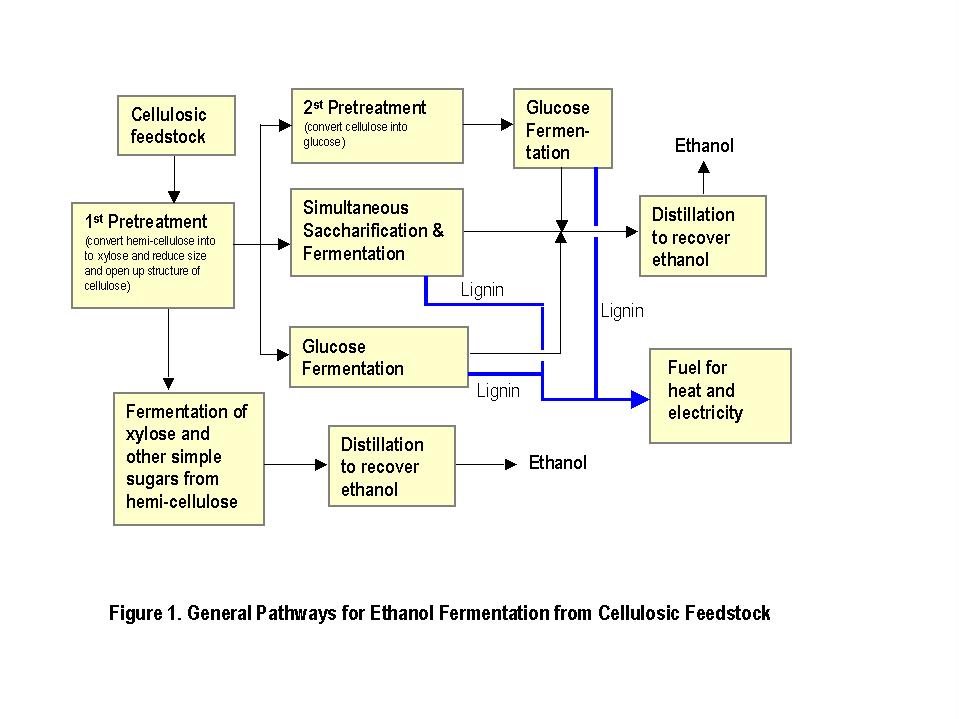
And the process of fermenting ethanol is a big water waster. In the fermentation process of ethanol you have 8% ethanol and 92% water that must be distilled and separated before the product is made. To my knowledge I have read nothing thus far that relays what is done with that water once it is distilled from the corn in the fermentation process (as the illustration above fails to show as well,) but I would think it could and should be reprocessed in some way to be of use in the growing of crops that people can use to eat. Any research on that will of course be posted here as I find the information.

In the following article this position regarding water scarcity and biofuel is also shared by Fred Pierce, author of:

"When The Rivers Run Dry":

Water Scarcity Seen Dampening Case For Biofuel
By David Brough
Thu Oct 19, 11:30 AM ET

GENEVA (Reuters) - Water scarcity harms the case for using food crops to make biofuels, a leading environmental author and journalist said on Thursday.

"The downside of growing food for fuel is water," said Fred Pearce, author of the book "When the Rivers Run Dry."

Surging crude oil prices have strengthened the argument for green energy created by cultivating food crops such as sugar cane to make ethanol fuel and vegetable oils to make biodiesel.

The politics of water will become critical as demand for water from rising populations and the needs of industry increase, said Pearce, editor of Britain's New Scientist magazine.

About one billion people lack access to clean drinking water, Pearce said in a keynote speech to the two-day Sugaronline conference in Geneva.

Vast quantities of water were needed to cultivate crops, with two-thirds of the world's water used in agriculture, Pearce said.

"Sugar is one of the thirstiest crops in the world," he said, estimating that 600-800 tonnes of water were required to grow one tonne of cane.

Brazil, the world's biggest sugar producer, has a thriving biofuels industry, converting about half its cane into fuel ethanol to power vehicles.

Pearce said the booming sugar business aimed at powering cars for the affluent had become a key component in water politics because of concerns over water scarcity.

In the past 30 years world food production had doubled to meet food demand from a growing population, but the amount of water used had tripled.

Part of the answer was to boost the efficiency of irrigation infrastructure.

"You can't irrigate the world's ethanol needs without huge gains in irrigation efficiency," Pearce said.

The Sugaronline conference ended on Thursday.
~~~~~~~~~~~
Also See:

David Pimental, a leading Cornell University agricultural expert, has calculated that powering the average U.S. automobile for one year on ethanol (blended with gasoline) derived from corn would require 11 acres of farmland, the same space needed to grow a year's supply of food for seven people. Adding up the energy costs of corn production and its conversion into ethanol, 131,000 BTUs are needed to make one gallon of ethanol. One gallon of ethanol has an energy value of only 77,000 BTUS. Thus, 70 percent more energy is required to produce ethanol than the energy that actually is in it. Every time you make one gallon of ethanol, there is a net energy loss of 54,000 BTUs.

Mr. Pimentel concluded that "abusing our precious croplands to grow corn for an energy-inefficient process that yields low-grade automobile fuels amounts to unsustainable subsidized food burning".

Neither increases in government subsidies to corn-based ethanol fuel nor hikes in the price of petroleum can overcome what Cornell University agricultural scientist, David Pimentel, calls a fundamental input-yield problem: It takes more energy to make ethanol from grain than the combustion of ethanol produces.

At a time when ethanol-gasoline mixtures (gasohol) are touted as the American answer to fossil fuel shortages by corn producers, food processors and some lawmakers, Cornell’s David Pimentel, one of the world’s leading experts in issues relating to energy and agriculture, takes a longer range view.

"Abusing our precious croplands to grow corn for an energy-inefficient process that yields low-grade automobile fuel amounts to unsustainable, subsidized food burning", says the Cornell professor in the College of Agriculture and Life Sciences. Pimentel, who chaired a U.S. Department of Energy panel that investigated the energetics, economics and environmental aspects of ethanol production several years ago, subsequently conducted a detailed analysis of the corn-to-car fuel process. His findings are published in the September, 2001 issue of the Encyclopedia of Physical Sciences and Technology.

Among his findings are:
Ethanol Fuel from Corn Faulted as ‘Unsustainable Subsidized Food Burning"
~~~~~~~~~~~~~~~~~~~~~~~~~~~~~~~~~~~~~
There are more efficient ways to sustain our planet and in the process also save water which is our most precious natural resource. Hopefully, the ethanol process can either be refined to save water and streamline the fermentation process wherein less energy is used to produce it. Otherwise, it is a wasteful fruitless exercise only meant to be used as a political wedge issue to bring profits to corporations beholding to the government not the people.

For my money solar energy is the only answer and one that does not use water in the process of it's production, and it needs to be pursued much more vigorously by the United States. The 21st Century is one where innovation and technology can lead us to a brighter and more productive future, but only if we take into account the moral and ethical codes that have existed for all times that must guide our choices. And we must not allow governments such as our own to use this crisis to exploit this issue for their own gain.

Tuesday, October 17, 2006

Kansas Aquifer Going Dry

The bottomline to this is the same as in many parts of the world. Humans overusing the water for economic gain not thinking of the future, and in the end having nothing. Excessive fines will either have to be imposed for overusing the water from the aquifer, or a way to import water from parts of the aquifer that have more water will have to be explored if possible but then again that gets people into battles over water rights. Another option could be to grow less water intensive crops combined with lessened growing of corn in order to conserve water.

Also, better water mangement to reuse irrigated water along with dry land irrigation and perhaps even introducing drip irrigation could be possible solutions to be put forth, but something has to be done soon. And of course, the fact that water is not seen as a viable issue to be discussed in a campaign because it is not a vote getter is tragic. Water is an issue that sustains our lives. How much more important can an issue be?

This isn't going to go away, and it isn't going to be remedied by replacement of water to the aquifer in large enough quantities to bring it back unless the required rainfall comes to Kansas and other areas, and in that case it would flood. Here we see many factors coming together. Human activity as far as waste and inefficient management of water resources, and climate change leading also to drought which brings inadequate rainfall to replace what has been used by the farmers.

And it will be hard to wean farmers off of growing corn or even halving their harvest which not only is a staple throughout he world, but is also their main cash crop. Again, balancing common sense practices with economic benefit seems to be becoming the hardest part of this crisis. And with the population reaching 300 million, there will also be more mouths to feed. I wonder as well what effect this will also have on the ethanol industry, as ethanol is made from corn, and corn is a very water intensive crop.

There will be updates to this as I find them.

Water Crisis Needs Attention

Water crisis demands attention
By Scott Rothschild (Contact)

Sunday, October 15, 2006

Beneath the soil of landlocked Kansas lies a vast, life-sustaining source of water called the High Plains aquifer. Formed millions of years ago, the aquifer — also referred to as the Ogallala — underlies an area of 174,000 square miles in parts of eight states, including most of western Kansas.

Since the 1940s, farmers have ferociously pumped the aquifer to produce food for a hungry nation and world. An estimated 15 million acre-feet of water per year are withdrawn for irrigation. One acre-foot of water is 325,851 gallons, or the amount it would take to cover an acre of land with one foot of water.

Now, in some areas of western Kansas, the aquifer has been sucked dry or is close to it, and farmers are shutting down wells. The effect of draining the source of water that grows a major portion of the nation’s crops has seismic repercussions.

“It’s a big, complex problem,” said Susan Stover, manager of the High Plains unit at the Kansas Water Office. “There will need to be a lot of changes. We can’t have near the amount of irrigated corn and alfalfa that we have. We don’t have the water.

Farmer Bill Spillman, viewed through the front window of a grain hauler driven by his employee Richard Rachel, heads into the fields to cut corn last Friday in Hoxie. Spillman uses both irrigation and dry-land farming methods. “The bottom line is, if everything was sustainable, we wouldn’t be tinkering with it,” she said.

Competing forces

It’s a simple equation. Agriculture is drawing more water from the aquifer than percolates back down through rainfall and runoff. The water table drops lower, making it impossible or financially impractical to pump water from below. The issue is made even more difficult because of the current seven-year drought and because some areas of the aquifer are nearly depleted while others have enough water for generations of irrigation.

More at the link
~~~~~~
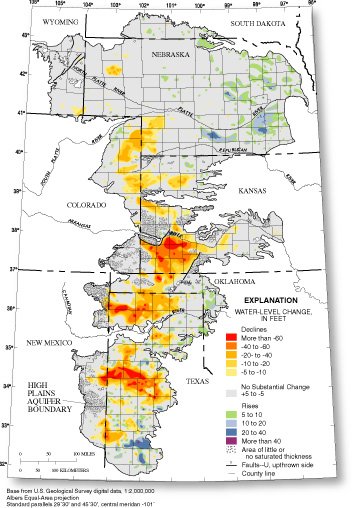
High Plains Aquifer Information


Water level changes in High Plains Aquifer from 1980-2002


USGS Image And Information

Sunday, October 15, 2006

Water Policy Around The World

Fantastic, useful, educational, and important program.

Water Policy Around The World

Talk of the Nation, October 13, 2006 · Increased demand for water around the world means that some sources are running dry, leaving areas without enough fresh water. More affluent areas are turning to untapped sources of water including desalination and creative reuse or recycling of existing water sources.

Guests:

Brent Haddad, associate professor of environmental studies, University of California


Sandra Postel, visiting senior lecturer in environmental studies at Mount Holyoke College, director of the Global Water Policy Project

Jerry Maxwell, general manager, Tampa Bay Water

Friday, October 13, 2006

Water At Risk For Millions Due To Melting Glaciers

Water At Risk For Millions Due To Melting Glaciers

Water for millions at risk as glaciers melt away ·
Crisis threatens parts of South America and Asia·
Decline accelerates as global warming takes hold

David Adam, environment correspondent
Wednesday October 11, 2006 The Guardian

The world's glaciers and ice caps are now in terminal decline because of global warming, scientists have discovered. A survey has revealed that the rate of melting across the world has sharply accelerated in recent years, placing even previously stable glaciers in jeopardy. The loss of glaciers in South America and Asia will threaten the water supplies of millions of people within a few decades, the experts warn.

Georg Kaser, a glaciologist at the University of Innsbruck, Austria, who led the research, said: "The glaciers are going to melt and melt until they are all gone. There are not any glaciers getting bigger any more."

Loss of land-based ice is one of the clearest signals of global temperature rise, and the state of glaciers has become a key argument in the debate over climate change. Last year, New Scientist magazine published a letter from the television botanist David Bellamy, a renowned climate sceptic, which claimed that 555 of 625 glaciers measured by the World Glacier Monitoring Service have been growing since 1980. His claim was quickly discredited, but the perception that glaciers are both growing and shrinking remains.

Dr Kaser said that "99.99% of all glaciers" were now shrinking. Increased winter snowfall meant that a few, most notably in New Zealand and Norway, got bigger during the 1990s, he said, but a succession of very warm summers since then had reversed the trend. His team combined different sets of measurements which used stakes and holes drilled into the ice to record the change in mass of more than 300 glaciers since the 1940s. They extrapolated these results to cover thousands of smaller and remote glaciers not directly surveyed.

The results revealed that the world's glaciers and ice caps - defined as all land-based ice except the mighty Greenland and West Antarctic ice sheets - began to shrink far more quickly in 2001. On average, the world's glaciers and ice caps lost enough water between 1961 and 1990 to raise global sea levels by 0.35-0.4 mm each year. For 2001-2004, the figure rose to 0.8-1mm each year.

Writing in the journal Geophysical Research Letters, the scientists say: "Late 20th century glacier wastage is essentially a response to post-1970 global warming." Dr Kaser said: "There is very, very strong evidence that this is down to human-caused changes in the atmosphere."
Emissions of greenhouse gases such as carbon dioxide trap heat in the atmosphere, warming the surface. One of the first impacts of glacier melting is likely to be in South America. In August, a report from 20 UK-based environment and development groups warned that Andean glaciers are melting so fast that some are expected to disappear within 15-25 years.

This would deny major cities water supplies and put populations and food supplies at risk in Colombia, Peru, Chile, Venezuela, Ecuador, Argentina and Bolivia.

Other countries are noticing the effects. Studies show snow and ice cover in the eastern Himalayas has shrunk by about 30% since the 1970s. Melting glaciers have created lakes in the mountains which could burst and cause widespread flooding. Of 150 glaciers that once stood in Glacier National Park in the northern US, only 27 remain. The US Environmental Protection Agency says the biggest are a third the size they were in 1850. Continued warming could melt them completely by 2030.
~~~~~~~~~~~~~~~~~~~~~~~~~~~~
Once again, the Chacaltaya Glacier in Bolivia:
http://www.reisebilder.ch/bolivien/chacafern_e.htm

Collapse of the Perito Moreno Glacier in Argentina
http://www.argentina.org.au/glacier_collapse.htm
And this was over two years ago with melting continuing.

And from NASA:
South American Glaciers Melting Faster

Glaciers Melting At Their Fastest Rate For 5000 Years


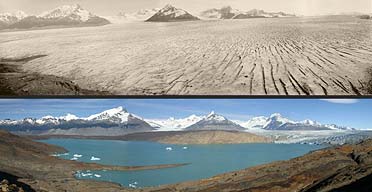
Retreating Glaciers Of Patagonia


View from the top ...
Two images of the Upsala glacier in Argentina show the retreat of the ice (top: 1928; bottom: 2004).
Photograph: Greenpeace/Reuters

~~~~~~~~~~~
Water scarcity is simply not just the process of fixing leaky pipes. Although infrastructure is absolutely one of the top concerns and priorities regarding this global crisis, it has been proven that human behavior regarding the burning of fossil fuels is also contributing to the water crisis in our world. Weather patterns particularly regarding rainfall also show in some cases not just a shift in patterns, but a complete reversal, and snows are not coming where they are needed to reverse this melting process.

The effects of these glaciers melting completely will then be past crisis stage if the people who depend on the freshwater provided from them and a rain/snowfall they cannot depend on are left with nothing to use for farming and other needs. Higher elevation farming will only lead to soil erosion and deforestation which in turn will then lead to flooding of crops, and effect the very way of life for thousands of people who without water to survive would then have no choice but to migrate elsewhere.

WE MUST FACE THIS NOW or we will suffer the consequences even more than we already are now, and it will be the poor of this world who will suffer more than any other group.

Wednesday, October 11, 2006

Hotter Planet Brings Chilling Outlook For Water In California

Hotter Planet Brings Chilling Outlook For Water In California

Earlier than usual Sierra snowmelt, along with expected greater rainfall, threatens to hamper the ability of reservoirs such as Hetch Hetchy to manage the runoff and keep valley flooding at bay.
A Look A Global Warming
Sunday's Water Works Stories
Monday's Water Works Stories


Last Updated: October 10, 2006, 07:26:03 AM PDT

Assuming the experts are correct, the day will come when there won't be enough water to go around in the Northern San Joaquin Valley, let alone the state. While no one can predict exactly when that day will arrive, a growing number of scientists and researchers insist it's an unstoppable force -- carrying with it any number of potentially devastating consequences.

A complex web of factors, including climate change, explosive growth and galloping urbanization, will reduce -- dramatically in some years -- the supply of clean surface and underground water. That could put the valley's ag-based economy in harm's way.

"We have droughts and floods," said Dennis Gudgel, Stanislaus County's ag commissioner. "It's always been that way. It's the availability of water that's more of a concern for farmers. It's a very serious issue." Experts say the competition for water will grow ever keener as the century pushes ahead. As for droughts and floods, the experts say they will become more frequent and harsh as temperatures rise.

Precipitation patterns also will change, but Michael Hanemann, director of the California Climate Change Center at the University of California at Berkeley, said that likely will prove to be far less significant than increasing temperatures.
~~~~~~~~~~~~~~~~~~~~~~~~~~~~~~~~~~~~~
Is this worth continuing to waste water filling your large swimming pools, and not giving a care for the ecosystems affected by your own waste and apathy? This isn't just a problem a world away, for those who think they can dismiss it and continue to waste water.

Improving Access To Water In Drylands

Desertification is environmental degradation caused primarily by human activity. Overgrazing, slash and burn techniques, deforestation, over population, climate change, and in varied instances drought that is prolonged leads to desertification. And in the case of the Aral Sea, the diverting of water resources:


Improving Access To Water In Drylands

UN Conference On Desertification

Policy Briefs

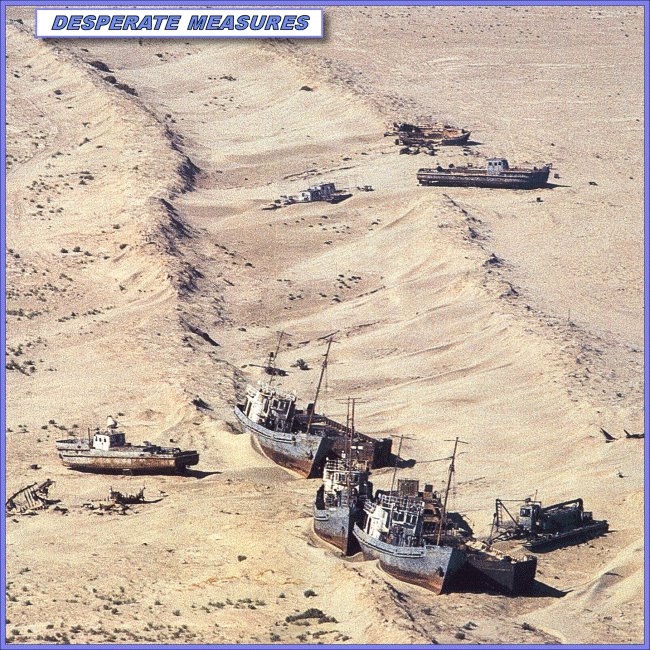
Once the fourth largest lake in the world, this is what human activity did to her.
The Aral Sea

And 2006 is the: International Year Of Deserts And Desertification

We can reverse this. We must reverse this. That is the hope.

Sunday, October 8, 2006

Drought In The American West


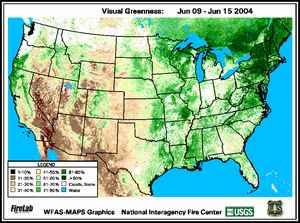
The Darker the color, the more severe the drought


Western Warming Warning

Climate change will worsen droughts, wildfires and die-offs in the region, a report says.

By Robert Lee Hotz, Times Staff Writer
October 6, 2006

Rising temperatures in the 11 Western states due to global warming will cause more prolonged droughts, more widespread wildfires, and extensive die-offs in regional plant, fish and game habitats, according to a report Thursday from the National Wildlife Federation.

"The American West is truly on the front line," said Patty Glick, the federation's global warming specialist. "The latest science is painting a bleak picture."

To address climate change, the organization urged national limits on the greenhouse gases responsible for rising temperatures, such as carbon dioxide and methane. California recently adopted such limits.

The national appetite for energy, fed by carbon-rich coal, oil and natural gas, imposes a double penalty on the ecological well-being of the West, said the group, which has 1 million members. The search for more fossil fuels — drilling permits on public lands have tripled in six years — disrupts fragile habitats even as increasing carbon dioxide alters the regional climate in ways that will make it impossible for many species to survive.

The federation report, called "Fueling the Fire," brings a regional focus to climate research findings from federal agencies, academia and science journals.

The researchers cited growing evidence that rising regional temperatures had already caused warmer winters, earlier springs and less snow — increasing the likelihood of winter flooding and of diminished summer water supplies.

All told, the winter snowpack, which is the source of 75% of the West's water, has declined by up to a third in the northern Rocky Mountain region and more than 50% in parts of the Cascades since 1950, the federation reported.

Indeed, the West is in the middle of a prolonged drought that may be the worst since record-keeping began more than a century ago — the direct consequence of altered weather patterns caused by warmer temperatures in the Pacific and Indian oceans, other research groups have reported.

As the Western landscape becomes more desiccated, wildfires become more common, more widespread and harder to control, experts said.

This past wildfire season was the most severe on record, said ecologist Steven W. Running at the University of Montana College of Forestry and Conservation.

More than 9.6 million acres burned over the summer — twice the seasonal average — and at $1.5 billion, the expense to fight them was the greatest ever.

"The warming trend we are under is clearly accelerating and expanding the wildfire activity," Running said.

"There is no reason we can see that it will reverse anytime soon."


--------------------------------------------------------------------------------
lee.hotz@latimes.com
~~~~~~~~
North American Drought Worst in 500 Years

How Drought Is Changing The American West

And if they run out of water, where will they get it?

Thursday, October 5, 2006

Drought Will Double To Hit Half The World By 2100

Last year was the warmest year at the Earth's surface since records began in the 1860s according to NASA, and new estimates state that temperatures could rise by 3 degrees Celsius this century triggering floods, droughts and famine. And yes, that IS a big deal for this fragile planet and for those species that live on it. There have been a myriad of reports from organizations all over this planet warning us of the repercussions of our actions and inactions. How many more will have to come out before we realize that what we are doing is causing irreparable harm to our only home?

If you have read any of my previous entries here you know for a fact that conditions in many parts of this world are already at a crisis stage regarding water resources and drought. Just alone on this small blog I have reported about the U.S. West as well as receding water in the Great Lakes and other areas, Canada, Mexico, The Middle East, Spain, Australia, Africa, Asia, South America, and other parts of Europe.

And I have also written about the violence that has ensued due to tribal wars over water, government intervention over the resources, privatization, and dams being built that divert water from indigenous peoples that take away their farmland, flood sacred landmarks, and do environmental damage. There are also reports of blatant corruption in government regarding water resource management.

I have also written about the droughts that have literally dried up rivers to the point where there is no water left (Such as the case of the Moreau River in South Dakota.) This is real, not just something I write about to take up time. I write about it because it is happening and because I believe people must know it is happening before they can take action to stop it. And I write about it because water is life and we are abusing it, wasting it, and using it as a weapon of greed, all to the detriment of our own future and that of future generations. And it cannot go on.

Some claim incredulity regarding the "water wars" warning, because they believe humans will always work out agreements regarding water resources because it is so much needed by all... sort of the MAD nuclear excuse. I would love to believe that would always be the case, but I don't see that in the future if present circumstances worsen as it is already happening now. There will come a point when the goodwill of men will run out unless we reign in the forces leading us to that point.
~~~~~~~~~~~~~~~~~~~~~~~~~~~~~~~~~~
Drought Will Double To Hit Half The World By 2100

By Ed Crooks, Energy Editor
Tue Oct 3, 3:30 PM ET

The incidence of moderate drought will double to affect half the world by the end of the century unless greenhouse gas emissions are curbed, according to a study backed by the British government.

Computer modelling of the effect of global warming on water levels conducted by the Met Office, Britain's official weather forecaster, also suggests that severe droughts could rise sharply, in the absence of action to limit emissions from the consumption of fossil fuels.

Worsening water shortages threaten to create growing problems of starvation and international conflict.

The Met Office predictions, to be published shortly in a US journal, are based on a projection of reasonably strong global economic growth, with no mitigation of greenhouse gas emissions. In that scenario, global temperatures rise by 1.3 to 4.5 degrees Celsius by the end of the century.

That would mean moderate drought - defined as water levels experienced during the driest fifth of months in a region in the past 50 years - occurring about 50 per cent of the time, the model indicates.

It also suggests a rise in extreme drought from 1 per cent at present to 30 per cent by the end of the century: although the Met Office scientists warned that they had less confidence in this prediction, as it was based on only a relatively small number of observations.

The incidence of moderate drought has already risen from about 15 per cent in the 30 or so years after 1950 to about 25 per cent today.

Because the definition of "drought" varies from place to place, its effects will differ.

Vicky Pope, head of the climate programme at the Met Office's Hadley Centre, said: "In the UK a drought could mean a hosepipe ban and other restrictions in water use. In Africa, it could mean people not having enough water to live."

The rise in drought predicted by the model is not uniform worldwide but is not confined to any specific continent or region, she said. Sub-Saharan Africa is one of the areas seen as suffering from more frequent droughts.

Andrew Simms of the New Economics Foundation, who discussed the Met Office findings at a fringe meeting at the Conservative party conference in Bournemouth on Tuesday, said: "Millions in Africa are already living under the shadow of drought.

Even small changes in rainfall can have severe negative effects. This research . . . reveals a fundamental disconnect between the scale of the problem and the current political response."
~~~~~~~~~~~~~~~~~~~~~~~~~~~~~~~~~~~
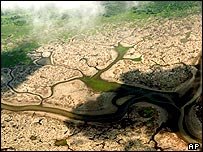
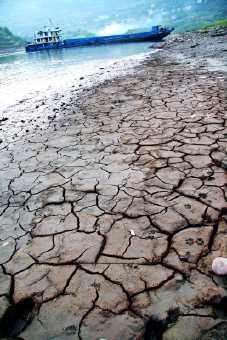
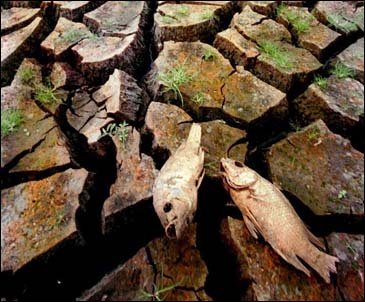
Do you really have to see the images to be moved?


Kenya


Amazon

United States


China

Spain

Australia, Pakistan


And lack of water caused by drought, that is now being exacerbated by human behavior causes famine, the silent killer of millions:

SUDAN
Is this truly the world you want for these innocent people and their children? For your children?
Is wasting it now worth it?