Just wait. Your water will one day be supplied by Coke or Pepsi, and you will pay through the nose for it. Water is now becoming a commodity to be traded with no value given to its intrinsic value as a human right... and that WILL affect human life.
Infrastructure in North America is in DESPERATE need of fixing, and politicians KNOW THIS but still do not plan for it. Instead, they allow it to crumble as our tax dollars are diverted to other projects of less importance so that privitization of resources can occur to make them money and give them more political clout.
They are exploiting this precious resource for their own gain at our expense... And it is being done subtly and quietly without many people in municipalities even in this country knowing what is going on regarding their own water supply. The price of water even in my own community has gone up FORTY PERCENT, but the money is not going to infrastructure or to provide better service, but to pay off BOND DEBT... Bonds that were issued to build a golf course... How ironic.
People, you need to do a little research as to what is going on regarding water in your own community. Predators in the private sector are just licking their chops to get in and take over your supply because there is now big business in water... and I predict that like in other countries around the world where the people are poor and vulnerable, the same tactics will be employed right here in the U.S., and the people have to stand up against it.
WATER IS A HUMAN RIGHT, not a commodity to be sold by Coke for a profit that only the rich will be able to afford!
~~~~~~~~~~~~~~~~~~~~~~~~~~~~~~~~~~~~~~~~~~~~~~~~~~
Water Is The New Oil CIBC
ROMA LUCIW
Globe and Mail Update
The colossal cost of fixing crumbling water infrastructure in the developed world has opened the door to government privatization.
Water delivery systems in the industrial world are in “dire need” of repair, says a report released Monday by CIBC World Markets Inc. At least one-fifth of America's municipal wastewater treatment facilities do not comply with federal regulations and in some U.S. cities, more than half of the water headed to consumers is lost along the way.
CIBC economist Benjamin Tal, author of the “Tapping into Water” report, estimates it will take “hundreds of billions of dollars” to fix dated water infrastructure in North America and Europe. Federal governments are not rushing to fix the infrastructure and municipalities lack the means to do so. “As a result, governments are now much more open to the notion of privatizing their water infrastructure which, in turn, is providing a substantial boost to the private water industry,” Mr. Tal said.
“What we are witnessing here is a trend that is profoundly modifying water as an investment theme throughout the world.”
Canada has one of the world's largest supplies of fresh water, but has its own water woes. Nearly a million British Columbia residents were placed on a boil-water advisory eleven days ago after heavy rainfall triggered mudslides and caused runoff into the Vancouver region's reservoirs, raising concerns about high levels of turbidity. The boil advisory was lifted on Monday.
Water contaminated with E. coli killed seven people and made thousands sick in Walkerton, Ont., six years ago. The bacteria entered the town's water supply from farm runoff, and residents had to boil or buy their water for seven months after their supply was tainted.
Meanwhile, the business of water is booming.
Mr. Tal sees parallels between today's water industry and the oil industry in its golden era, before and after the Second World War. “The market is paying attention,” he said. “Capital investment, deregulation, consolidation, and privatization of global water assets and services are advancing at a pace not seen before.”
In the last three years, U.S.-based water companies — as measured by the Bloomberg U.S. water index — have surged 150 per cent, three times the rise seen by companies on the S&P 500, while paying twice as much in dividends. International water players are doing even better, Mr. Tal said, with their stock values rising twice as fast as their American counterparts in the past year alone.
Water is an attractive investment because it is much less volatile than industries driven by economic cycles, Mr. Tal said. Companies that specialize in “water solutions” can range from pumps, pipes and valves, wastewater treatment, to quality testing. European companies account for half of the global water players, while American companies make up 36 per cent. In Canada, there are few ways for investors to directly invest in H2O. However, the Canada Pension Plan Investment Board recently launched a bid for a British water utility. “Water prices in many industrialized countries are now rising much faster than inflation, and this trend will only accelerate in the coming years,” Mr. Tal said.
World Bank estimates suggest that outsourcing and privatization in the water sector are set to double in the coming five years to reach a near 40 per cent share of the market. “If crumbling water infrastructures in North America and Europe provide the private water industry with great opportunities, the potential in the developing world is even greater,” Mr. Tal said.
More at the link.
~~~~~~~~~~
Also see:
Water Must Go To Those Who Deserve It Most, The Rich
If you live in the U.S. and your water is supplied by a private company, then say hello to your new owner as of 2002:
RWE
Which bought out:
American Water
Now in 16 states.
Remember, it's all about PROFIT.
~~~~~~~~~~~~~~~~~~~~~~~~~~~~~~~~~~~~~~~
UPDATE: 11.30.06
New Report Questions The Future Of American Water
Tuesday, November 28, 2006

Monday, November 27, 2006
Iraq Worried About Turkish Dam
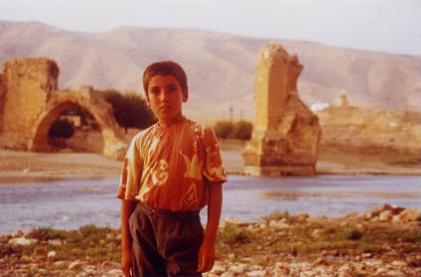
A Kurdish boy in front of the bridge in Hasankeyf, Turkey, which will be drowned if the Ilisu Dam is built. The base of the bridge dates back to the 7th century
©International Rivers Network Kurdish Human Rights Project
~~~~~~~~~~~~
The Iraqi people haven't been through enough. Now they have to worry about their water being taken away...what little they have. Isn't it also so coincidental that where ever we start a war, water is an issue as well as oil? Isn't it also so outrageous how history can simply be washed away without a thought when greed takes over that process?
~~~~~
Iraq Worried About Turkish Dam
SHARING THE TIGRIS RIVER
Iraq Worried about Turkish Dam
The Ilisu Dam will, when it's finished, provide hydroelectric power in south-eastern Turkey. Iraq, though, is worried it may also cut flows of the vital Tigris River.
Officials in Iraq are angered by Turkish plans to construct a gigantic dam on the river Tigris in southeast Turkey, near the Iraqi border. The so-called Ilisu Dam's 300 square kilometer reservoir would be a significant source of hydroelectric power, and Turkey's Prime Minister Recep Tayyip Erdogan said at an opening ceremony on Aug. 5 that it "will bring big gains to the local people." But in Iraq, health officials are concerned that these gains will come at the expense of their own people.
Photo Gallery: The Treasure Turkey Will Lose
Click on a picture to launch the image gallery (6 Photos)
"There is no doubt that this will lead to a significant deterioration of the water quality" in Iraq, said Latif Rashid, Baghdad's Minister of Water Resources, in a letter to the Germany-based NGO World Economy, Ecology and Development (WEED). Iraq is also concerned that the new dam project could hamper the flow of water into the country via the 1,900 kilometer long Tigris River. The river begins in Turkey and flows into Iraq through the south-eastern Turkish town of Cizre.
The Ilisu Dam is part of the larger Southeast Anatolia Project, a 21-dam plan to expand hydro-electric energy production in the under-developed and largely Kurdish southeast. But it's a project that is no stranger to international criticism with the Ilisu Dam attracting particular attention. In 1999, the Kurdish Human Rights Project (KHRP) revealed that its completion would result in the flooding of Hasankeyf, an ancient city of particular cultural import to the Kurdish minority. Criticism has only grown since construction started in August.
Now, though, even the German government is worried about the construction's potentially negative effects on Turkey's troubled neighbor, Iraq. The project is being realized by an international consortium of construction firms, including the German firm Züblin. Officials in Berlin now face the delicate decision of granting export credits to a controversial project.
Government officials on Friday said that Ankara would need to guarantee the minimum water levels for neighboring Iraq before it would approve export credits. But WEED spokeswoman Heike Drillisch urged the government not to support the initiative. "The complaints from Baghdad show that international standards and human rights are being ignored," she said.
Meanwhile, the Turkish Foreign Ministry reacted with indignation to the accusations. It played down the Iraqi complaints, asserting that Iraqi delegates have not even mentioned the issue in direct talks with Turkey. A spokesperson for the Turkish government gave assurances that minimum water levels would be maintained for Iraq, and that the government is open for talks.
amb/spiegel
~~~~~~~~~~~~
This is a very comprehensive site regarding the entire Ilisu Dam project and the socio-economic, political, and environmental impacts of this project that in my view is only being done for political blackmail.
The Ilisu Dam Project
Make no mistake about it: with drought in this area already causing water tables in the Tigris to be at only 50% capacity or lower, this dam will only make matters worse for those who rely on the Tigris for sustinence, and that could lead to conflict for this most precious resource of the Middle East.
The Water Wars
And again, what side does the U.S. fall on in this? The Bush regime occupies Iraq, brings about a civil war that is killing thousands of people including our own, and then dares to say we bring Democracy in the face of destroying their infrastructure (including water) in the face of all of this?
Despicable.
Also see my other entries on this topic:
The Ilisu Dam Controversy
Iraq's Marshes, Corporate Control, and Water Scarcity
Saturday, November 25, 2006
Afghanistan's Neglected Drought
Afghanistan's Neglected Drought
Afghanistan's neglected drought
Increasing violence in Afghanistan has overshadowed hardship caused by drought. Christian Aid's Anjali Kwatra writes about the problem in the western province of Herat.
In pictures: Afghan drought
In a graveyard on a hill overlooking the village of Sya Kamarak in western Afghanistan, villagers gathered last week for the funerals of three young children who died of hunger.
They died on the same day from malnutrition caused by a devastating drought that has hit western, northern and southern Afghanistan.
There were no doctors' reports to confirm the cause of death - the parents were too poor to take them to the clinic which is one day's walk away.
Jan Bibi, 40, said she had been feeding her three-month-old daughter Nazia with just boiled water and sugar because she had nothing else.
"My baby died because of inadequate food. I wanted to breastfeed her but I was not producing enough milk."
Jan Bibi's surviving twin daughter Merzia is the size of a newborn rather than a three-month old and cries continually for food.
Dry spell
"I am worried about my baby," said Jan Bibi. "The future is dark because we don't have food or water or fuel for heating. We have to walk for four hours to get to the nearest fresh water - we don't know how we will survive."
Failed crops turn to stocks for burning (Photos: Christian Aid)
The villagers say 50 children have died so far this year - a far higher number than usual - because of the drought.
Almost all the 300 families in remote Sya Kamarak, which is a day's drive along bumpy tracks from the capital of the province, Herat city, live off the land.. Most lost all their wheat harvest when the rains failed in April and May.
A Christian Aid assessment of the drought in five northern and western provinces showed that farmers lost 80-100% of their crops in the worst affected areas and water sources in many villages had dried up.
More at the link above.
~~~~~~~
In pictures: Afghan Drought
Afghanistan's Drought
War has ravaged this country for almost thrity years, and now lack of rainfall is also killing its children. Where is the U.S? Since we too are still in their country after almost five years, what is our responsibility regarding this crisis? Are we going to stand and just watch their children die?
According to the most recent estimates I could find, approximately 12% of the land is arable, but now with drought and extreme soil evaporation that may be less. Permanent pastures average about 46% of the land with about 4% as forests and woodlands which may now also be much less due to deforestation because of remaining forests being cut down to use them for fuel and building materials. Desertification due to dry conditions is also a current environmental issue for Afghanistan as it is for the entire region.

Photo courtesy of NASA.
Dust Storm/Afghanistan/Pakistan
Also see:

Water Management In Central Asia
Would the people of Afghanistan stand up to fight for water? Wouldn't you? I am sure to many Americans and others in this world, the suffering these people in Afghanistan and in this area of the world in general are going through regarding lack of water is incomprehensible.
That needs to change because if we don't change our ways, within the next 45 years more of this world will be a desert, and the water that is left will be the property of those who can afford it and have the power to make it theirs alone.
Australia, China, Afghanistan, Africa...and that is only the beginning. How much of our world will we turn into a wasteland before we realize what we have lost? And if you think the constant dropping of bombs on the land has no effect on the atmosphere nor the conditions in Afghanistan, think again. It isn't only our behavior regarding what we put up in the atmosphere that needs to change, it is also what we rain down.
Afghanistan's neglected drought
Increasing violence in Afghanistan has overshadowed hardship caused by drought. Christian Aid's Anjali Kwatra writes about the problem in the western province of Herat.
In pictures: Afghan drought
In a graveyard on a hill overlooking the village of Sya Kamarak in western Afghanistan, villagers gathered last week for the funerals of three young children who died of hunger.
They died on the same day from malnutrition caused by a devastating drought that has hit western, northern and southern Afghanistan.
There were no doctors' reports to confirm the cause of death - the parents were too poor to take them to the clinic which is one day's walk away.
Jan Bibi, 40, said she had been feeding her three-month-old daughter Nazia with just boiled water and sugar because she had nothing else.
"My baby died because of inadequate food. I wanted to breastfeed her but I was not producing enough milk."
Jan Bibi's surviving twin daughter Merzia is the size of a newborn rather than a three-month old and cries continually for food.
Dry spell
"I am worried about my baby," said Jan Bibi. "The future is dark because we don't have food or water or fuel for heating. We have to walk for four hours to get to the nearest fresh water - we don't know how we will survive."
Failed crops turn to stocks for burning (Photos: Christian Aid)
The villagers say 50 children have died so far this year - a far higher number than usual - because of the drought.
Almost all the 300 families in remote Sya Kamarak, which is a day's drive along bumpy tracks from the capital of the province, Herat city, live off the land.. Most lost all their wheat harvest when the rains failed in April and May.
A Christian Aid assessment of the drought in five northern and western provinces showed that farmers lost 80-100% of their crops in the worst affected areas and water sources in many villages had dried up.
More at the link above.
~~~~~~~
In pictures: Afghan Drought
Afghanistan's Drought
War has ravaged this country for almost thrity years, and now lack of rainfall is also killing its children. Where is the U.S? Since we too are still in their country after almost five years, what is our responsibility regarding this crisis? Are we going to stand and just watch their children die?
According to the most recent estimates I could find, approximately 12% of the land is arable, but now with drought and extreme soil evaporation that may be less. Permanent pastures average about 46% of the land with about 4% as forests and woodlands which may now also be much less due to deforestation because of remaining forests being cut down to use them for fuel and building materials. Desertification due to dry conditions is also a current environmental issue for Afghanistan as it is for the entire region.
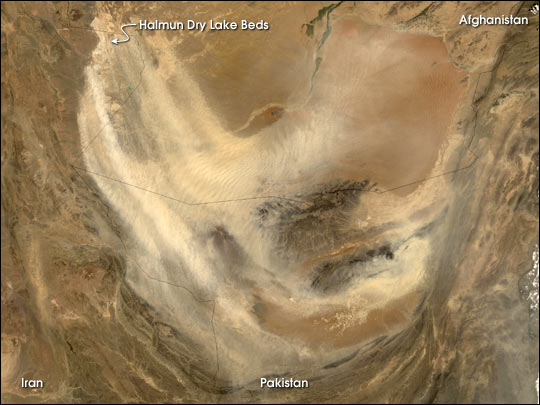
Photo courtesy of NASA.
Dust Storm/Afghanistan/Pakistan
Also see:
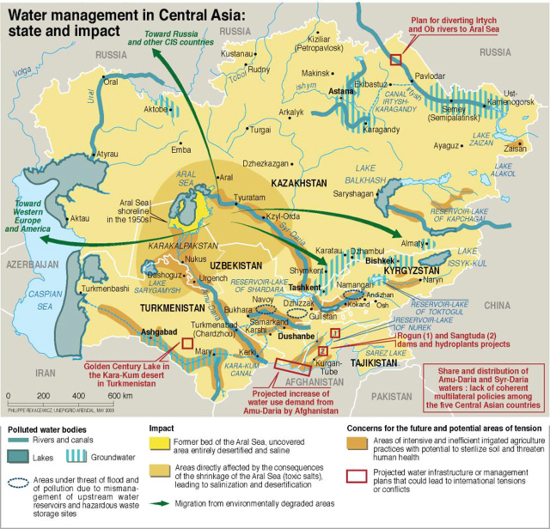
Water Management In Central Asia
Would the people of Afghanistan stand up to fight for water? Wouldn't you? I am sure to many Americans and others in this world, the suffering these people in Afghanistan and in this area of the world in general are going through regarding lack of water is incomprehensible.
That needs to change because if we don't change our ways, within the next 45 years more of this world will be a desert, and the water that is left will be the property of those who can afford it and have the power to make it theirs alone.
Australia, China, Afghanistan, Africa...and that is only the beginning. How much of our world will we turn into a wasteland before we realize what we have lost? And if you think the constant dropping of bombs on the land has no effect on the atmosphere nor the conditions in Afghanistan, think again. It isn't only our behavior regarding what we put up in the atmosphere that needs to change, it is also what we rain down.
Friday, November 24, 2006
Would You Drink This Water?
This Thanksgiving, be thankful for POTABLE WATER.
A Resident Collects Water from a Water Storage Tank on the Outskirts of Suining
Mail this picture to a friend
CHINA: November 24, 2006
A resident collects water from a water storage tank on the outskirts of Suining, southwest China's Sichuan province, November 19, 2006.
Officials with southwest China's Sichuan Province and Chongqing Municipality made pledges at an ongoing conference about drought relief that they will strengthen the water conservancy construction "at all costs" to avoid the recurrence of the droughts affecting the two places this summer, Xinhua News Agency reported.
Photo by STRINGER
REUTERS NEWS PICTURE SERVICE

A Resident Collects Water from a Water Storage Tank on the Outskirts of Suining
Mail this picture to a friend
CHINA: November 24, 2006
A resident collects water from a water storage tank on the outskirts of Suining, southwest China's Sichuan province, November 19, 2006.
Officials with southwest China's Sichuan Province and Chongqing Municipality made pledges at an ongoing conference about drought relief that they will strengthen the water conservancy construction "at all costs" to avoid the recurrence of the droughts affecting the two places this summer, Xinhua News Agency reported.
Photo by STRINGER
REUTERS NEWS PICTURE SERVICE
Tuesday, November 21, 2006
Outback Spirit Dries Up In Face Of Record Drought
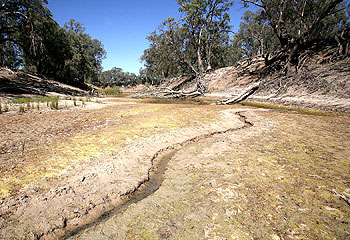
The Darling River in Australia as it looks today.
Unbelievable.
Outback Spirit Dries Up In Face Of Record Drought
By Nick Squires in Bourke
Last Updated: 3:54am GMT 20/11/2006
One of the most celebrated Outback towns has been pushed to the brink of social and economic collapse as a result of the worst drought in Australia's history.
Bourke, in the parched west of New South Wales, was enshrined in frontier mythology by 19th-century bush poets such as Henry Lawson, who declared: "If you know Bourke, you know Australia."
The expression "back o'Bourke" is understood by all Australians to mean in the middle of nowhere.
But the town's resilience has been pushed to breaking point by six years of drought, the worst "big dry" since the British settled in Australia in 1788.
Unless the drought breaks soon, Bourke will become "an economic and social disaster" according to a recent report by economists at Charles Sturt University in New South Wales.
The drought is taking its toll on towns across the Outback, but its effect on Bourke, 485 miles north west of Sydney, is particularly acute.
Unlike other towns in the bush, Bourke has no mining to fall back on. Its reliance on irrigation for vast cotton fields and citrus plantations also makes it vulnerable to the lack of rain.
The town's lifeblood, the Darling River, is dwindling by the day beneath a blazing blue sky, its sluggish waters an unhealthy pea green.
"This used to be a good fishing spot, but look at it now," said publican Lachlan Ford, surveying a section of the river, reduced to a patchwork of sandbanks, gravel shoals and fetid black pools. "We're coming into summer, when the temperature won't dip much below 40C for three months," he added.
There has been no cotton crop for three years because of the lack of water and the orange orchards are dying.
Kangaroos lie panting on a lawn in front of an office building on the outskirts of town and a pair of emus barely manage to break into a run when startled by the side of the road.
Without sufficient grazing, farmers have had to either sell all their sheep and cattle or buy in fodder at great expense. Sixty pastoral stations in the Shire of Bourke – an area about the size of Denmark – have no animals left at all.
Desperate graziers have taken to rounding up the flocks of feral goats that inhabit the scrub. Until recently dismissed as pests, they are now the only thing left to sell.
"Our dams [reservoirs] are depleted and we're running out of water," said Graham Brown, 58, who owns a 430,000-acre farm 190 miles west of Bourke.
"We're holding on by the skin of our teeth, but if we don't get any rain this summer, we'll be hitting the panic button."
Bourke's population has dropped in the last three years from 3,500 to less than 3,000. Shops on the main street are boarded up and houses are for sale.
"This is the worst drought white men have seen in this country," said mayor Wayne O'Mally. "It's really testing people's resources."
The drought has prompted an intense debate in Australia about the effects of global warming and whether some areas are becoming too dry for farming.
The government, which refuses to sign the Kyoto Protocol, insists there is no proven connection between climate change and the present drought. Scientists disagree. While the debate rages, the people of the Outback can only look to the skies and pray for a change in the hot, dry weather.
~~~~~~~~~~~~~~~~~~~~~~~~~~~~~~~~~~~~~~~~~~~~~~~~~~~~~~~~~~~~
And while this goes on, PM Howard meets with the coal industry to secure his campaign coffers. Disgraceful.
The Darling River which is the longest river in Australia and has six other rivers as tributaries is at dangerously low levels due to overuse of its waters, pollution from toxic runoff, and the most severe and prolonged drought in over a hundred years due in part to anthropogenic climate change.
Right now what Australia needs is not political posturing, but definitive action to mitigate this crisis and bring hope and sustinence back to the people of Bourke and other areas affected by it. And people NEED TO CHANGE THEIR WAYS as well, because as the Darling River crisis shows, mismanagement and misuse of water resources especially in light of the scientific consensus regarding climate change is not only irresponsible, but deadly.
In the words of Henry Lawson:
The skies are brass and the plains are bare,
Death and ruin are everywhere;
And all that is left of the last year's flood
Is a sickly stream on the grey-black mud;
The salt-springs bubble and the quagmires quiver,
And this is the dirge of the Darling River.
Is that really the legacy PM Howard wants to be remembered for?
Also see:
Darling Dry As A Bone
Threatened Species Of The Darling River
Friday, November 17, 2006
Tibet's Lofty Glaciers Melt Away
Tibet's Lofty Glaciers melt Away
Research by scientists shows that the ice fields on the roof of the world are disappearing faster than anyone thought.
By Clifford Coonan
Published: 17 November 2006
The Qinghai-Tibet plateau is home to tens of thousands of glaciers, fields of ice at the roof of the world where Mount Everest and other Himalayan peaks look down on China and Nepal. But the glaciers are melting faster than anyone thought, fresh research by Chinese scientists shows, as global warming speeds up the shrinkage of more than 80 per cent of the 46,377 glaciers on the lofty plateau.
Rising temperatures on the ice fields of Qinghai-Tibet and surrounding areas in the past 50 years are having a devastating effect on the environment, as receding glaciers translate into water shortages in China and huge swathes of south Asia. China will soon have to add more deserts, droughts and sandstorms to its already lengthy list of pollution woes, while India and Nepal will have to deal with staggering environmental consequences, as the melting lakes of ice threaten essential natural resources for the large population centres at the foot of the mountain ranges.
About 47 per cent of China's glaciers are on the Qinghai-Tibet plateau in the Himalayas, where the Yangtze, Yellow, Brahmaputra, Mekong and Salween rivers all originate. The rate of melting, estimated at some 7 per cent a year, has meant more water run-off from the plateau, which worsens soil erosion and leads to desertification. It is an environmental nightmare for rivers such as the Yangtze, 20 per cent of which is fed by glaciers, while the Taklamakan Desert in north-west China could be flooded before later drying out, researchers say.
Research just released by China's leading scientific body, the Chinese Academy of Sciences, shows global warming is dealing a hammer blow to ice fields at some of the world's truly awesome mountain regions. This week the United Nations warned that Tibet's glaciers could disappear within 100 years due to global warming.
"Almost all glaciers in China have already shown substantial melting," the UN Development Programme said in its 2006 Human Development Report. "This is a major threat to China's over-used and polluted water supplies. The 300 million farmers in China's arid western region are likely to see a decline in the volume of water flowing from the glaciers." The melting glaciers have not led to more water flowing into China's dry north and west because much of the melted glacier water is evaporated before it reaches the country's drought-stricken farmers, again as a result of global warming.
In the past 40 years, glaciers across the Tibetan plateau that spills from China into South Asia have shrunk by 6,600 square kilometres, especially since the 1980s, the conservation group WWF said in a 2005 report. The glaciers now cover about 105,000 square kilometres, it said. It is not just the glaciers of Tibet that are melting - 95 per cent of Alaska's glaciers are thinning, too. Global temperatures rose about 0.6C during the 20th century, and the consensus among scientists is that warming will continue as long as greenhouse gases, primarily carbon dioxide from the burning of fossil fuels, accumulate in the atmosphere.
China is the world's fastest-growing major economy, but it has only a quarter of the world's average water per person, and rampant economic growth has sharpened competition for water resources.The Qinghai-Tibet plateau covers 2.5 million square kilometres - about a quarter of China's land surface - at an average altitude of four kilometres above sea level. The world's highest ice fields are a natural biological museum for the array of geological phenomena they contain. The temperature has risen by 0.2C every 10 years, according to the Cold and Dry Zone Environment and Engineering Research Institute of the Chinese Academy of Sciences.
The institute's scientists selected 5,000 glaciers in the region for study, using remote sensors and other methods for gathering geographical information, to monitor changes over the past 50 years, Liu Shiyin, one of the scientists taking part in the programme, told the Xinhua news agency.The results were harrowing. Liu said only a small number of glaciers were expanding And about 82 per cent of the monitored glaciers had receded by 4.5 per cent in the past 50 years.
The rate of shrinkage in glaciers in the central and northwestern parts of the Qinghai-Tibet plateau was slightly slower, but it was noticeably faster in neighbouring areas. Of 170 glaciers on the northwestern slope of the Qilian Mountains, a range of peaks in the northern province of Gansu formerly known as the Richthofen Range, 95 per cent had thinned by 4.9 metres each year on average. Only 10 glaciers had expanded during the period. In the Tianshan Mountains in Xinjiang province, almost all the glaciers on the northern slopes, and 69 per cent of glaciers on the southern slopes, were dwindling.
In the Pamir Mountains of Central Asia, site of the 72km long Fedchenko Glacier, the world's longest ice field outside the polar region, the glacier acreage shrank by 10 per cent. Glaciers on the northern slopes of the Kunlun Mountains, which stretch for 3,000km to form the border of Northern Tibet, are shrinking, as are the ice fields of the Himalayas, which are home to the world's tallest mountain, Mount Everest.
Global warming is causing China's highland glaciers, including those covering Everest, to shrink by an amount equivalent to all the water in the Yellow River every year. Monitoring results show the flow of water in some rivers in north-west China's dry regions has been increasing, which was possibly a result of melting glaciers, Liu said. Liu warned that if glaciers continued to melt at such a high rate, it "would impose serious impact on local production and the life of local people". In Nepal, where temperatures rise an average of 0.06C per year, snow-fed rivers are declining, and water levels are getting lower on the wetlands of the Qinghai Plateau. Melting icefields are expected to trigger more droughts in an already parched China, expand desertification and increase the frequency of sandstorms.
More at the link.
~~~~~~
And those sandstorms are already increasing in intensity and occurence:
Bejing Is Covered In Dust
Sandstorms Effect Air Quality in Bejing
China MUST join the world in curbing its emissions of fossil fuels. 300 million people in these arid lands depend on the rivers that are made up of approximately 20% of the glaciers that are now melting at an alarming rate. And without water, there is no food, and there is no life.
Also see:
Frozen Soil Thawing Faster Endangering Qinghai-Tibet Railway
Wednesday, November 15, 2006
Clean Water Is A Human Right
Clean Water Is A Human Right
Clean water is a human right
Kevin Watkins / International Herald Tribune
Published: November 10, 2006
NAIROBI: Vivian Neyamba, aged six months, just became another grim statistic in the world's most lethal and least reported humanitarian disaster. She lost her life not to a drought, a flood or a violent conflict, but to a killer that claims the lives of 500 children across the world each day - diarrhea caused by a global crisis in water and sanitation.
I have been following these issues for years. But standing outside the tiny corrugated iron shack in the sprawling slum of Kibera in Nairobi, where Vivian Neyamba lived her short life, I got a heartbreaking glimpse into what it actually means to live without clean water and basic sanitation.
In a slum of more than half a million people, the largest informal settlement in Africa, almost no one has a tap in their home. At dawn, armies of women and young girls line up with buckets to buy water at roadside standpipes from private vendors. On a bad day, they have to wait more than an hour, or go without.
You can smell the sanitation crisis in the air. Kibera is a toilet-free zone. Lacking any alternative, people defecate into plastic bags which are thrown into ditches. Raw sewage is everywhere. It is in the noxious black liquid that floods through people's homes when it rains, in the refuse heaps that children play in, and in the dusty lanes that pass for streets.
It is also in the water that people drink. Fractured pipes carrying water from the mains to the standpipes suck in raw sewage. "That is why our children get sick," says Margaret Olewoch, a birth attendant who has lived in Kibera for 20 years, pointing to a leaking pipe. "The water here is dangerous."
Not everyone in southern Nairobi faces a daily water crisis. Cross Ngang Road, which marks the northern perimeter of the slum, and you enter a different water world. Here the water sprinklers of the Royal Nairobi Golf Club work overtime to keep the greens in a condition to which the city's business elite and diplomatic corps are accustomed.
Back on the other side of Ngang Road, water kills children. Typhoid and dysentery are rampant, with child death rates running at almost four times the average for Nairobi. The slums of Kibera are a microcosm of one of the greatest development challenges of the 21st century. More than a billion people today lack clean water. About 2.6 billion - half of the developing world's population - lack access to sanitation.
These twin deficits inflict enormous human, social and economic costs. Unclean water is the second biggest killer of children, claiming more than two million lives annually. Diseases caused by water keep countless millions more children out of school, reinforce poverty, and act as a brake on economic growth. They cost African countries about 5 percent of their gross domestic product - equivalent to what the region receives in aid. Under the Millennium Development Goals, governments have pledged to halve by 2015 the proportion of people without access to water and sanitation. But at the rate we are going, this crucial goal will be missed.
The governance of water markets is at the heart of the problem. All too often, the poorer you are, the more you pay. Municipal water utilities provide cheap water, usually heavily subsidized, to industry and high-income suburbs, while people living in slums rely on a complex web of intermediaries such as tanker-truck operators and water vendors.
You can see the results in Nairobi. People living in the slums of Kibera pay five times more for their water than the Royal Nairobi Golf Club. In fact, they pay more per liter than people living in New York or London. From Manila, to Mumbai and Jamaica, the same story applies in slums across the world. So what can be done to tackle the global crisis in water and sanitation?
Continued at the link above.
~~~~~~
The Human Right To Water
Very comprehensive report from seven years ago that is still relevant today.
My comments:
Access to resources that sustain life and maintain health are a human right under international law. Water is a resource that sustains life from the time of being a fetus in the womb. Without water there would be no food to sustain us, nor to provide us with safe and adequate sanitation facilities that guard against diseases that cause illness and death.
I believe for any community or country to deny such a right to its people is a human rights abuse that should be punishable under that law. Of course however, there are groups that do not wish for water to be declared a universal human right. Those governments that use water as a political weapon or as a way to divert it to richer areas are only two groups of people as well as corporations that would be prone to oversight and fines for violating the human rights of indigenous people on the lands they take water from to make a profit.
They will claim water should not be declared a human right as to avert wars, but in essence it is the quality, lack of and scarcity of water resulting from higher prices, lower quality, lack of moral will in bringing sensible water management and education to underdeveloped countries, diversion, privitization, dams, and environmental policies that cause drought and deforestation that actually lead to the wars. People can and have always come to agreements among themselves. It is only when governments and other entities with ulterior motives get in between for their own benefit that you see problems begin.
World Water Forum Did Not Declare Clean Water To Be A Human Right
Look to the WORLD BANK to also see why this declaration will not happen. The World Bank actually pushes for privitization of water behind their compassionate facade.
World Bank And WTO/ Corporate Control Of Water/Dr. Vandana Shiva
There are thousands of Vivian Neyambas in this world, and they all die early senseless deaths that could be prevented if their fellow humans had the slightest bit of morality above the insensitivity and ignorance that prevails in a world gone mad with greed. What price do you place on a human life?
Clean water is a human right
Kevin Watkins / International Herald Tribune
Published: November 10, 2006
NAIROBI: Vivian Neyamba, aged six months, just became another grim statistic in the world's most lethal and least reported humanitarian disaster. She lost her life not to a drought, a flood or a violent conflict, but to a killer that claims the lives of 500 children across the world each day - diarrhea caused by a global crisis in water and sanitation.
I have been following these issues for years. But standing outside the tiny corrugated iron shack in the sprawling slum of Kibera in Nairobi, where Vivian Neyamba lived her short life, I got a heartbreaking glimpse into what it actually means to live without clean water and basic sanitation.
In a slum of more than half a million people, the largest informal settlement in Africa, almost no one has a tap in their home. At dawn, armies of women and young girls line up with buckets to buy water at roadside standpipes from private vendors. On a bad day, they have to wait more than an hour, or go without.
You can smell the sanitation crisis in the air. Kibera is a toilet-free zone. Lacking any alternative, people defecate into plastic bags which are thrown into ditches. Raw sewage is everywhere. It is in the noxious black liquid that floods through people's homes when it rains, in the refuse heaps that children play in, and in the dusty lanes that pass for streets.
It is also in the water that people drink. Fractured pipes carrying water from the mains to the standpipes suck in raw sewage. "That is why our children get sick," says Margaret Olewoch, a birth attendant who has lived in Kibera for 20 years, pointing to a leaking pipe. "The water here is dangerous."
Not everyone in southern Nairobi faces a daily water crisis. Cross Ngang Road, which marks the northern perimeter of the slum, and you enter a different water world. Here the water sprinklers of the Royal Nairobi Golf Club work overtime to keep the greens in a condition to which the city's business elite and diplomatic corps are accustomed.
Back on the other side of Ngang Road, water kills children. Typhoid and dysentery are rampant, with child death rates running at almost four times the average for Nairobi. The slums of Kibera are a microcosm of one of the greatest development challenges of the 21st century. More than a billion people today lack clean water. About 2.6 billion - half of the developing world's population - lack access to sanitation.
These twin deficits inflict enormous human, social and economic costs. Unclean water is the second biggest killer of children, claiming more than two million lives annually. Diseases caused by water keep countless millions more children out of school, reinforce poverty, and act as a brake on economic growth. They cost African countries about 5 percent of their gross domestic product - equivalent to what the region receives in aid. Under the Millennium Development Goals, governments have pledged to halve by 2015 the proportion of people without access to water and sanitation. But at the rate we are going, this crucial goal will be missed.
The governance of water markets is at the heart of the problem. All too often, the poorer you are, the more you pay. Municipal water utilities provide cheap water, usually heavily subsidized, to industry and high-income suburbs, while people living in slums rely on a complex web of intermediaries such as tanker-truck operators and water vendors.
You can see the results in Nairobi. People living in the slums of Kibera pay five times more for their water than the Royal Nairobi Golf Club. In fact, they pay more per liter than people living in New York or London. From Manila, to Mumbai and Jamaica, the same story applies in slums across the world. So what can be done to tackle the global crisis in water and sanitation?
Continued at the link above.
~~~~~~
The Human Right To Water
Very comprehensive report from seven years ago that is still relevant today.
My comments:
Access to resources that sustain life and maintain health are a human right under international law. Water is a resource that sustains life from the time of being a fetus in the womb. Without water there would be no food to sustain us, nor to provide us with safe and adequate sanitation facilities that guard against diseases that cause illness and death.
I believe for any community or country to deny such a right to its people is a human rights abuse that should be punishable under that law. Of course however, there are groups that do not wish for water to be declared a universal human right. Those governments that use water as a political weapon or as a way to divert it to richer areas are only two groups of people as well as corporations that would be prone to oversight and fines for violating the human rights of indigenous people on the lands they take water from to make a profit.
They will claim water should not be declared a human right as to avert wars, but in essence it is the quality, lack of and scarcity of water resulting from higher prices, lower quality, lack of moral will in bringing sensible water management and education to underdeveloped countries, diversion, privitization, dams, and environmental policies that cause drought and deforestation that actually lead to the wars. People can and have always come to agreements among themselves. It is only when governments and other entities with ulterior motives get in between for their own benefit that you see problems begin.
World Water Forum Did Not Declare Clean Water To Be A Human Right
Look to the WORLD BANK to also see why this declaration will not happen. The World Bank actually pushes for privitization of water behind their compassionate facade.
World Bank And WTO/ Corporate Control Of Water/Dr. Vandana Shiva
There are thousands of Vivian Neyambas in this world, and they all die early senseless deaths that could be prevented if their fellow humans had the slightest bit of morality above the insensitivity and ignorance that prevails in a world gone mad with greed. What price do you place on a human life?
Tuesday, November 14, 2006
Water Clash Evoked By Climate Talks
Water Clash Evoked By Climate Talks
Water Clash Warning Evoked by Kenya Climate Talks
KENYA: November 14, 2006
NAIROBI - Global climate change talks in Nairobi this week may be nowhere more relevant than a nearby settlement where water shortages a year ago sparked clashes which saw 25 people speared, clubbed or chopped to death.
Masai herdsmen and settled farmers say the rains have changed on the flat plains that spread uninterrupted between distant mountains in Kenya's Rift Valley. And a year ago drought lit the touch paper to old rivalries over who owns what land, triggering a pitched battle between two sides wielding machetes, arrows, spears and clubs.
"It's the first time water was the cause," said Zacharia Igeria, chief administrator in the 50,000-strong community of the Maai Mahiu region some 50 km (30 miles) from Nairobi.
Drought last year shrank the river Ewasu Kidong, which is Masai for "water jug", to exceptionally low levels, Igeria said.
Water and pasture shortages in the past three years have decimated Masai cattle herds by four-fifths, the herdsmen say. The dwindling of the vital local river coupled with farmers' plans to divert its waters to irrigate cash crops sparked the conflict 12 months ago, Igeria said.
Disrupted rain cycles are the type of weather changes many scientists predict will become more frequent as a result of climate change, as mankind releases heat-trapping gases into the atmosphere.
Deforestation has also been blamed for more frequent droughts in Africa. Elders of the local Masai had never heard of global warming nor the UN climate change conference less than two hour's drive away in Nairobi, but wanted to give a message to the 70-plus environment ministers descending on the capital.
"We're not educated, we're not aware of climate change," local Masai elder William Sayo told Reuters and local journalists. "We need help from you to explain how we can live according to the climate. Come and teach us about what is happening."
More at the link.
~~~~~~~~~~
The bolded sentence above is exactly the crux of this problem worldwide. Ignorance about the real effects of climate change and the inability to or lack of will to get this information to people who need it and to teach them how to mitigate it is simply unacceptable. People should not have to die to get water. We should not be killing each other for it. We have what we need to provide water to EVERYONE IN THIS WORLD. What we need to do is take it upon ourselves to become educators.
I think that like the Peace Corps, we need a Sustainability Corps that travels the world to offer education, tools, and hope to people in areas of the world like Kenya in order to assist them in taking action to protect and conserve their natural resources. And we must also take into account that for many in this world water is a sacred fluid, and not having rain is seen as a sign from God. They cannot understand the scientific facts behind climate change, nor do they have many of the skills and tools necessary to harvest rainwater that they may get. And I ask , why not?
It is unconscienable that people of this world should thirst for knowledge as well as water and not have it given to them, especially regarding a situation that is a matter of life and death.
See:
African Conservation Foundation
Water Scarcity Major Crisis Facing Africa
Saturday, November 11, 2006
UN Urges End To "Water Apartheid"
Some may think this too harsh, but I believe this is environmental genocide... A systematic killing of the poor in order for the rich to get the spoils by using the environment as their weapon. And in regards to water it is even more insidious, as water does not exclusively belong to any one person. It is a human right, not a commodity to be bought and sold on a market or used as a weapon of war or a political wedge.
What truly angers me is the "water forums" that take place every year but that never really address the issue of the rich taking advantage of the poor regarding this. They never face the huge corporate conglomerates that are making billions of dollars in profits while poor people(mainly children) in underdeveloped countries die daily of water borne diseases and lack of potable water.
It is IMMORAL for these companies to continue making profit off of a resource that is not a commodity and is in short supply in so many areas of this world where it is most needed. Governments constantly talk about what needs to be done, but it never gets done. It takes DECADES to get anywhere, and in that time span more children die. What is so hard to understand about this? PEOPLE ARE DYING FROM LACK OF WATER AND SANITARY CONDITIONS and we have what we need to make sure THAT DOESN'T CONTINUE. So why does it continue?
Political powerplaying, corruption, greed, prejudiuce, and relying on a World Bank that actually pushes privatization of this resource is all we get because of those who see an opportunity to use a crisis to their advantage rather than act in a moral fashion.
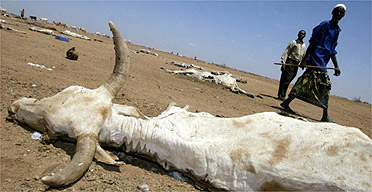
Should we see wars for this resource in the near future, it will be because of the lack of caring on the part of those rich enough to afford it, who don't care about anyone else. It will be because of their arrogance in becoming part of the solution in mitigating this climate crisis which they feel they are not responsible for. It will be because people in countries such as our own did not stand up to demand equal treatment for all and sound fair measures regarding water management. The picture below is a strong indictment of the human race, and we better get our act together, because time is running out.
Read my other entry on this:
When The Gift of Life Becomes Deadly
~~~~~~~~~~~~~~~~~~~~~~~~~~~~~
UN urges end to 'water apartheid'
By David Loyn
BBC Developing World correspondent
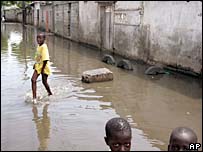
UN Urges End To "Water Apartheid"
Water-borne diseases kill five times as many children as HIV/Aids
A new report from the United Nations Development Programme has demanded a big increase in spending to provide clean water.
The UNDP wants another $4bn (£2bn) a year spent, and says that water has not received the attention it deserves.
Water-borne diseases such as diarrhoea kill far more people than HIV/Aids and malaria combined, it said.
We sometimes lose sight of the sheer depth of inequality
Kevin Watkins, lead author, Human Development Report
And the difference is particularly stark for children: water-borne diseases kill five times as many children as HIV/Aids.
The report says that water is a key part of human development - and warns that, in particular, sub-Saharan Africa is lagging behind the rest of the world in the provision of basic services.
Rich unaffected
The report says that 2.4 billion people in the world do not have access to safe sanitation.
Some steps are simple and can have dramatic results - just putting in a safe standpipe can reduce mortality by 20%.
But Kevin Watkins, the report's author, says that the world needs to think on a much bigger scale than this.
He says a similar initiative is needed as that carried out 100 years ago in major European cities, including London, to provide water and sewage treatment.
Human Development Report 2006: Beyond scarcity [7.8MB]
Most computers will open this document automatically, but you may need Adobe Reader
Download the reader here
Global climate efforts 'woeful'
Back then, diseases such as cholera, carried in dirty water, were affecting the rich as well as the poor.
In the modern world of what Mr Watkins calls "water apartheid", the rich do not suffer in the same way, and the incentives for government to act are less.
"You can't help wondering - if the children of the wealthy were suffering the same fate as the children of the poor regarding water and sanitation, if high income women were also walking four hours a day to collect water - whether something would have been done about it."
"I think something would have happened a long time ago."
Huge costs
The report finds that the big arguments about privatisation in recent years miss the point.
There have been some high-profile failures where western companies have not been able to deliver their promises in developing countries.
Some of the world's poorest are paying the most for their water
But slum dwellers in places including Nairobi in Kenya already pay for private water supplies, delivered by truck.
The amounts they pay are huge and this water is more expensive per litre than in London or New York.
The poorest people in Latin America can pay up to 10% of their household income for water.
Climate change
As well as the loss of life and the cost of disease, the time spent collecting water has other economic effects.
The report calculates that the cost to Africa is equivalent to about 5% of the continent's economic growth, about the same amount of growth as is generated by money received in aid.
Mr Watkins says: "This is one of the biggest potential setbacks to human development in Africa for a century."
But he says that water has been left out of recent announcements on development by the richest countries in the world.
The report does not believe that water represents a major security threat, and the prospect of 'water wars' is not as serious as others have predicted.
But it does warn of severe consequences if there is not a major strategic plan for water use across country borders, especially as climate change reduces the capacity of the poorest countries to grow food for themselves.
Growing inequality
The report highlights the growing gap between rich and poor, not only in income, but also in the provision of basic services.
And it shows the glaring gaps not just between rich and poor countries, but between the rich and poor within developing countries.
Children in Indonesia, for example, are four times as likely to die before their fifth birthday if they are born into the poorest 20% of the population instead of the richest 20%.
And the combined income of the richest 500 people in the world exceeds that of the poorest 416 million.
The report says that one of the central challenges of human development is to "diminish tolerance for the extreme inequalities that have characterised globalisation since the 1990s."
"Globalisation has given rise to a protracted debate over trends in global income distribution, but we sometimes lose sight of the sheer depth of inequality, and how greater equity could dramatically accelerate poverty reduction," Mr Watkins said.
What truly angers me is the "water forums" that take place every year but that never really address the issue of the rich taking advantage of the poor regarding this. They never face the huge corporate conglomerates that are making billions of dollars in profits while poor people(mainly children) in underdeveloped countries die daily of water borne diseases and lack of potable water.
It is IMMORAL for these companies to continue making profit off of a resource that is not a commodity and is in short supply in so many areas of this world where it is most needed. Governments constantly talk about what needs to be done, but it never gets done. It takes DECADES to get anywhere, and in that time span more children die. What is so hard to understand about this? PEOPLE ARE DYING FROM LACK OF WATER AND SANITARY CONDITIONS and we have what we need to make sure THAT DOESN'T CONTINUE. So why does it continue?
Political powerplaying, corruption, greed, prejudiuce, and relying on a World Bank that actually pushes privatization of this resource is all we get because of those who see an opportunity to use a crisis to their advantage rather than act in a moral fashion.
Should we see wars for this resource in the near future, it will be because of the lack of caring on the part of those rich enough to afford it, who don't care about anyone else. It will be because of their arrogance in becoming part of the solution in mitigating this climate crisis which they feel they are not responsible for. It will be because people in countries such as our own did not stand up to demand equal treatment for all and sound fair measures regarding water management. The picture below is a strong indictment of the human race, and we better get our act together, because time is running out.
Read my other entry on this:
When The Gift of Life Becomes Deadly
~~~~~~~~~~~~~~~~~~~~~~~~~~~~~
UN urges end to 'water apartheid'
By David Loyn
BBC Developing World correspondent
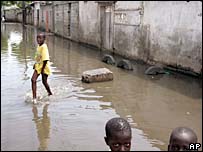
UN Urges End To "Water Apartheid"
Water-borne diseases kill five times as many children as HIV/Aids
A new report from the United Nations Development Programme has demanded a big increase in spending to provide clean water.
The UNDP wants another $4bn (£2bn) a year spent, and says that water has not received the attention it deserves.
Water-borne diseases such as diarrhoea kill far more people than HIV/Aids and malaria combined, it said.
We sometimes lose sight of the sheer depth of inequality
Kevin Watkins, lead author, Human Development Report
And the difference is particularly stark for children: water-borne diseases kill five times as many children as HIV/Aids.
The report says that water is a key part of human development - and warns that, in particular, sub-Saharan Africa is lagging behind the rest of the world in the provision of basic services.
Rich unaffected
The report says that 2.4 billion people in the world do not have access to safe sanitation.
Some steps are simple and can have dramatic results - just putting in a safe standpipe can reduce mortality by 20%.
But Kevin Watkins, the report's author, says that the world needs to think on a much bigger scale than this.
He says a similar initiative is needed as that carried out 100 years ago in major European cities, including London, to provide water and sewage treatment.
Human Development Report 2006: Beyond scarcity [7.8MB]
Most computers will open this document automatically, but you may need Adobe Reader
Download the reader here
Global climate efforts 'woeful'
Back then, diseases such as cholera, carried in dirty water, were affecting the rich as well as the poor.
In the modern world of what Mr Watkins calls "water apartheid", the rich do not suffer in the same way, and the incentives for government to act are less.
"You can't help wondering - if the children of the wealthy were suffering the same fate as the children of the poor regarding water and sanitation, if high income women were also walking four hours a day to collect water - whether something would have been done about it."
"I think something would have happened a long time ago."
Huge costs
The report finds that the big arguments about privatisation in recent years miss the point.
There have been some high-profile failures where western companies have not been able to deliver their promises in developing countries.
Some of the world's poorest are paying the most for their water
But slum dwellers in places including Nairobi in Kenya already pay for private water supplies, delivered by truck.
The amounts they pay are huge and this water is more expensive per litre than in London or New York.
The poorest people in Latin America can pay up to 10% of their household income for water.
Climate change
As well as the loss of life and the cost of disease, the time spent collecting water has other economic effects.
The report calculates that the cost to Africa is equivalent to about 5% of the continent's economic growth, about the same amount of growth as is generated by money received in aid.
Mr Watkins says: "This is one of the biggest potential setbacks to human development in Africa for a century."
But he says that water has been left out of recent announcements on development by the richest countries in the world.
The report does not believe that water represents a major security threat, and the prospect of 'water wars' is not as serious as others have predicted.
But it does warn of severe consequences if there is not a major strategic plan for water use across country borders, especially as climate change reduces the capacity of the poorest countries to grow food for themselves.
Growing inequality
The report highlights the growing gap between rich and poor, not only in income, but also in the provision of basic services.
And it shows the glaring gaps not just between rich and poor countries, but between the rich and poor within developing countries.
Children in Indonesia, for example, are four times as likely to die before their fifth birthday if they are born into the poorest 20% of the population instead of the richest 20%.
And the combined income of the richest 500 people in the world exceeds that of the poorest 416 million.
The report says that one of the central challenges of human development is to "diminish tolerance for the extreme inequalities that have characterised globalisation since the 1990s."
"Globalisation has given rise to a protracted debate over trends in global income distribution, but we sometimes lose sight of the sheer depth of inequality, and how greater equity could dramatically accelerate poverty reduction," Mr Watkins said.
Tuesday, November 7, 2006
A Hotter Drier Australia A Reality

Graphic on the rainfall in Australia. Prime Minister John Howard has called an emergency drought summit as climate change and rising interest rates threaten a 10-year economic boom -- and his grip on power.
(AFP/Graphic/Martin Megino)
"Frightening" Study Predicts Hotter, Drier Australia
Michael Perry
SYDNEY (Reuters) - Australia's climate is now permanently hotter and drier, and the country faces major temperature rises and significantly less rainfall by 2070, scientists said on Monday.
The projections, described by one official as a "frightening picture", were published as Australia grapples with its worst drought in 100 years and follows Prime Minister John Howard's recent conversion to the view that global warming is real.
The government's Commonwealth Scientific and Industrial Research Organization (CSIRO) predicted in a report that rainfall in parts of eastern Australia were forecast to drop 40 percent by 2070, with a seven degree Celsius rise in temperature.
It said that by 2030 the risk of bushfires will be higher, droughts more severe and rainfall and stream run-off lower.
By 2070, the town of Gunnedah in western New South Wales state will have more than 100 days a year with temperatures over 35 Celsius (95 degrees Fahrenheit) and Walgett may have 83 days a year above 40 Celsius (104 Fahrenheit), said the report.
Such constantly high temperatures could turn normally drought-proof green pastures into brown dustbowls.
"The CSIRO research paints a frightening picture. That's why we need a national approach to climate change," said New South Wales state Premier Morris Iemma.
Howard, although now conceding the existence of climate change, still refuses to sign the Kyoto Protocol aimed at lower greenhouse gas emissions, arguing it is flawed because it does not include big polluters India, China and the United States.
Story continued at the link.
~~~~~~~~~~~~~~~~~~~~~~~
Australia is suffering through it's worst drought in 100 years, with farmers committing suicide, and Australia perched on economic ruin because of it. It is about time that PM John Howard realized that this issue goes beyond political rhetoric and goes to the heart of humanity, even if he had to be pushed into it due to the circumstances.
Drastic steps need to now be initiated in Australia to keep this situation from getting any worse, and that includes a plan to reduce CO2 emissions from the burning of fossil fuels. Australia cannot afford to continue to listen to skeptics with ulterior objectives. The lives of many including livestock hang in the balance.
The projection of rainfall decrease by 40% with rising temperatures alone is something Australia cannot afford as that would be cataclysmic to all life, and would at worst scenario preclude a mass exodus from Australia because the land would be dead.
Friday, November 3, 2006
Argentina Slams Uruguay Water Permit to Botnia
Update:
ARGENTINA: November 7, 2007

A man casts his shadow on a wall built by environmentalists to block the road linking the Argentine city of Gualeguaychu and the Uruguayan city of Fray Bentos. Argentina and Uruguay have been embroiled in an environmental row for more than a year over the construction of a paper pulp mill by Finland's company Metsa-Bonia in Fray Bentos, a town on the Uruguay River that divides the two countries. Argentines say they are concerned about contamination and the impact on tourism and fishing, while Uruguayans insist the project is environmentally safe.
Photo by MARCOS BRINDICCI /REUTERS NEWS PICTURE SERVICE

Argentine environmentalists block a road linking the Argentine city of Gualeguaychu and the Uruguayan city of Fray Bentos during a protest against the construction of paper pulp mills October 13, 2006. Argentina and Uruguay have been embroiled in an environmental row for more than a year over the construction of paper pulp mills in Fray Bentos, a town on the Uruguay River that divides the two countries. The sign reads 'Spain and Finland, terrorists of environment'. REUTERS/Andres Stapff (URUGUAY)
Argentina Slams Uruguay Water Permit to Botnia
ARGENTINA: November 3, 2006
BUENOS AIRES, Argentina - Argentina formally complained to Uruguay on Wednesday about a permit that country issued to Finnish forestry group Metsa-Botnia to extract water from the shared Uruguay River, the latest dispute in a wider battle over Botnia's pulp mill project.
Argentina has challenged the mill at the International Court of Justice in The Hague, claiming neighboring Uruguay violated a bilateral treaty by not providing enough information on the riverside project. Buenos Aires went on the offensive again on Wednesday, saying Uruguay had made another "unilateral" decision in September when it authorized Botnia to extract "a significant volume" of water from the shared river.
"This aggravates a situation that is already tense between the two countries," Argentine Foreign Minister Jorge Taiana said in a letter to his Uruguayan counterpart, adding that the decision could affect the quality and quantity of river water.
Argentina fears the mill, which is due to begin operating in the third quarter of 2007, will damage the environment and also hurt tourism and fishing in the area.
Environmentalists in Argentina have blocked highways leading to Uruguay in protest over the project, costing Uruguay millions of dollars, Montevideo has said.
The court in The Hague refused to order a halt to construction, but a broader decision is not expected until late next year, sources at Argentina's foreign ministry have said.
Spain's Ence had planned to build a pulp plant next to Botnia's mill, but the company announced it would relocate it. The two mills were estimated to cost about US$1.7 billion, representing the largest private investment in Uruguay's history.
~~~~~~~~~~~~
The Uruguay River
Metsa Botnia
Uruguay:Paper Mill Will Damage River
Just another story illustrating tensions between countries regarding water and the exploitation of this resource by governments and corporations that put profit first.
People In Uruguay Fight For Their Water Rights
Guarani Acquifer
And speaking of the Guarani Acquifer, take a look at this:
Bush Buys Land in Northern Paraguay
Buenos Aires, Oct 13 (Prensa Latina) An Argentine official regarded the intention of the George W. Bush family to settle on the Acuifero Guarani (Paraguay) as surprising, besides being a bad signal for the governments of the region.
Luis D Elia, undersecretary for the Social Habitat in the Argentine Federal Planning Ministry, issued a memo partially reproduced by digital INFOBAE.com, in which he spoke of the purchase by Bush of a 98,842-acre farm in northern Paraguay, between Brazil and Bolivia.
The news circulated Thursday in non-official sources in Asuncion, Paraguay.
D Elia considered this Bush step counterproductive for the regional power expressed by Presidents Nestor Kirchner, Luiz Inacio Lula da Silva, Evo Morales, Hugo Chavez and Fidel Castro.
He said that "it is a bad signal that the Bush family is doing business with natural resources linked to the future of MERCOSUR."
The official pointed out that this situation could cause a hypothetical conflict of all the armies in the region, and called attention to the Bush family habit of associating business and politics.
ef ccs tac rmh
PL-38
~~~~~
Do they want to get to the water first?
ARGENTINA: November 7, 2007
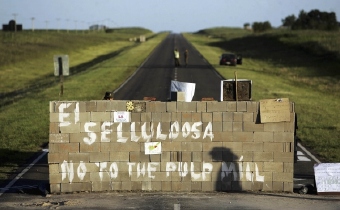
A man casts his shadow on a wall built by environmentalists to block the road linking the Argentine city of Gualeguaychu and the Uruguayan city of Fray Bentos. Argentina and Uruguay have been embroiled in an environmental row for more than a year over the construction of a paper pulp mill by Finland's company Metsa-Bonia in Fray Bentos, a town on the Uruguay River that divides the two countries. Argentines say they are concerned about contamination and the impact on tourism and fishing, while Uruguayans insist the project is environmentally safe.
Photo by MARCOS BRINDICCI /REUTERS NEWS PICTURE SERVICE

Argentine environmentalists block a road linking the Argentine city of Gualeguaychu and the Uruguayan city of Fray Bentos during a protest against the construction of paper pulp mills October 13, 2006. Argentina and Uruguay have been embroiled in an environmental row for more than a year over the construction of paper pulp mills in Fray Bentos, a town on the Uruguay River that divides the two countries. The sign reads 'Spain and Finland, terrorists of environment'. REUTERS/Andres Stapff (URUGUAY)
Argentina Slams Uruguay Water Permit to Botnia
ARGENTINA: November 3, 2006
BUENOS AIRES, Argentina - Argentina formally complained to Uruguay on Wednesday about a permit that country issued to Finnish forestry group Metsa-Botnia to extract water from the shared Uruguay River, the latest dispute in a wider battle over Botnia's pulp mill project.
Argentina has challenged the mill at the International Court of Justice in The Hague, claiming neighboring Uruguay violated a bilateral treaty by not providing enough information on the riverside project. Buenos Aires went on the offensive again on Wednesday, saying Uruguay had made another "unilateral" decision in September when it authorized Botnia to extract "a significant volume" of water from the shared river.
"This aggravates a situation that is already tense between the two countries," Argentine Foreign Minister Jorge Taiana said in a letter to his Uruguayan counterpart, adding that the decision could affect the quality and quantity of river water.
Argentina fears the mill, which is due to begin operating in the third quarter of 2007, will damage the environment and also hurt tourism and fishing in the area.
Environmentalists in Argentina have blocked highways leading to Uruguay in protest over the project, costing Uruguay millions of dollars, Montevideo has said.
The court in The Hague refused to order a halt to construction, but a broader decision is not expected until late next year, sources at Argentina's foreign ministry have said.
Spain's Ence had planned to build a pulp plant next to Botnia's mill, but the company announced it would relocate it. The two mills were estimated to cost about US$1.7 billion, representing the largest private investment in Uruguay's history.
~~~~~~~~~~~~
The Uruguay River
Metsa Botnia
Uruguay:Paper Mill Will Damage River
Just another story illustrating tensions between countries regarding water and the exploitation of this resource by governments and corporations that put profit first.
People In Uruguay Fight For Their Water Rights
Guarani Acquifer
And speaking of the Guarani Acquifer, take a look at this:
Bush Buys Land in Northern Paraguay
Buenos Aires, Oct 13 (Prensa Latina) An Argentine official regarded the intention of the George W. Bush family to settle on the Acuifero Guarani (Paraguay) as surprising, besides being a bad signal for the governments of the region.
Luis D Elia, undersecretary for the Social Habitat in the Argentine Federal Planning Ministry, issued a memo partially reproduced by digital INFOBAE.com, in which he spoke of the purchase by Bush of a 98,842-acre farm in northern Paraguay, between Brazil and Bolivia.
The news circulated Thursday in non-official sources in Asuncion, Paraguay.
D Elia considered this Bush step counterproductive for the regional power expressed by Presidents Nestor Kirchner, Luiz Inacio Lula da Silva, Evo Morales, Hugo Chavez and Fidel Castro.
He said that "it is a bad signal that the Bush family is doing business with natural resources linked to the future of MERCOSUR."
The official pointed out that this situation could cause a hypothetical conflict of all the armies in the region, and called attention to the Bush family habit of associating business and politics.
ef ccs tac rmh
PL-38
~~~~~
Do they want to get to the water first?
Wednesday, November 1, 2006
China Is IRRESPONSIBLE
Toxic Spill Cuts Off Water To Thousands In China
By GILLIAN WONG, Associated Press Writer
1 hour, 11 minutes ago
BEIJING - Water supplies to 28,000 people in northern China have been cut after an overturned truck spilled 33 tons of toxic oil into a river, state media said Wednesday, the latest mishap involving the country's already polluted waterways.
The overloaded truck was carrying wash oil, also known as creosote, when it overturned and dumped its contents into a river in Shanxi province, Xinhua News Agency reported. An investigation showed the truck overturned due to brake failure, the report said.
The spill flowed into the Yangjiapo reservoir, contaminating 70 million cubic feet of water, the agency said, citing the provincial environmental bureau.
Supplies to the towns of Dazhai and Sandu in Xiyang county, which the reservoir serves, have been cut, Xinhua said.
The spill occurred Oct. 26, Xinhua said, but did not say why it was reported a week later.
Cleanup crews were using pumps, tons of activated carbon and other materials to absorb the spill, the agency reported.
Authorities were trucking in drinking water to affected residents, and were trying to connect water pipes to a large well in the nearby village of Mahui, Xinhua said.
Most of China's canals, rivers and lakes are severely tainted by agricultural and household pollution. Chinese leaders say the country faces a critical water shortage, in part because of chronic pollution and chemical accidents.
In August, China said it would spend $125 billion to improve water treatment and recycling by 2010 to fight the mounting threat of urban water pollution.
In November 2005, a chemical plant blast spilled tons of benzene and other toxic material into the Songhua River, halting water supplies to millions in China and Russia. Local authorities were accused of reacting too slowly and delaying public disclosure of the spill.
~~~~~~~~~~~~~~~~~~~~~~~~~~~~~~~~~~~~~~~~~~~
Also see my earlier entries on China;
China, Worst Water Crisis In The World
So much for their economic boom. Who is getting rich from it? Certainly not the people. The government of this country is blatantly wasting and allowing the pollution of their most precious resource for profit. Sooner or later the candle will burn to the middle, and then what? Raise prices on comsumers when it is the industrial pollution and government mismanagement and graft that is killing the water supply? And here is the kicker: they don't want to piss off the industries by actually making them pay for their pollution however, because they might go away... so that is worth the continued toxification of their country. Sounds familiar, doesn't it?
China Is Damned
And just how safe is the water being used by farmers to irrigate their crops if 90% of their groundwater is polluted? It is simply irresponsible of China to not enact strict measures to penalize polluters and conserve water. Most water is wasted in the irrigation process, and considering the excessive drought China has been going through in part due to climate change, conservation and water reprocessing techniques need to be enacted yesterday. And Tibet should not have to pay the price for China's irresponsible behavior, And China's water Resource Minister agrees that their plan to steal Tibet's water is not feasible.
This is a conundrum of their own making, and it is immoral to continue along the road they are on. With economic progress comes responsibility, and that includes carbon emission caps along with effective management of resources. You cannot claim progress without that.
China Turns To Desalinization To Ease Water Crisis
I wonder where the energy to run the plants is going to come from as there is a fuel shortage as well. Also, the desalinization process contributes to climate change in higher carbon emissions. This is just a temporary bandaid that does not address the waste and climate change that is causing this drought, besides overpopulation concentrated in urban areas.
By GILLIAN WONG, Associated Press Writer
1 hour, 11 minutes ago
BEIJING - Water supplies to 28,000 people in northern China have been cut after an overturned truck spilled 33 tons of toxic oil into a river, state media said Wednesday, the latest mishap involving the country's already polluted waterways.
The overloaded truck was carrying wash oil, also known as creosote, when it overturned and dumped its contents into a river in Shanxi province, Xinhua News Agency reported. An investigation showed the truck overturned due to brake failure, the report said.
The spill flowed into the Yangjiapo reservoir, contaminating 70 million cubic feet of water, the agency said, citing the provincial environmental bureau.
Supplies to the towns of Dazhai and Sandu in Xiyang county, which the reservoir serves, have been cut, Xinhua said.
The spill occurred Oct. 26, Xinhua said, but did not say why it was reported a week later.
Cleanup crews were using pumps, tons of activated carbon and other materials to absorb the spill, the agency reported.
Authorities were trucking in drinking water to affected residents, and were trying to connect water pipes to a large well in the nearby village of Mahui, Xinhua said.
Most of China's canals, rivers and lakes are severely tainted by agricultural and household pollution. Chinese leaders say the country faces a critical water shortage, in part because of chronic pollution and chemical accidents.
In August, China said it would spend $125 billion to improve water treatment and recycling by 2010 to fight the mounting threat of urban water pollution.
In November 2005, a chemical plant blast spilled tons of benzene and other toxic material into the Songhua River, halting water supplies to millions in China and Russia. Local authorities were accused of reacting too slowly and delaying public disclosure of the spill.
~~~~~~~~~~~~~~~~~~~~~~~~~~~~~~~~~~~~~~~~~~~
Also see my earlier entries on China;
China, Worst Water Crisis In The World
So much for their economic boom. Who is getting rich from it? Certainly not the people. The government of this country is blatantly wasting and allowing the pollution of their most precious resource for profit. Sooner or later the candle will burn to the middle, and then what? Raise prices on comsumers when it is the industrial pollution and government mismanagement and graft that is killing the water supply? And here is the kicker: they don't want to piss off the industries by actually making them pay for their pollution however, because they might go away... so that is worth the continued toxification of their country. Sounds familiar, doesn't it?
China Is Damned
And just how safe is the water being used by farmers to irrigate their crops if 90% of their groundwater is polluted? It is simply irresponsible of China to not enact strict measures to penalize polluters and conserve water. Most water is wasted in the irrigation process, and considering the excessive drought China has been going through in part due to climate change, conservation and water reprocessing techniques need to be enacted yesterday. And Tibet should not have to pay the price for China's irresponsible behavior, And China's water Resource Minister agrees that their plan to steal Tibet's water is not feasible.
This is a conundrum of their own making, and it is immoral to continue along the road they are on. With economic progress comes responsibility, and that includes carbon emission caps along with effective management of resources. You cannot claim progress without that.
China Turns To Desalinization To Ease Water Crisis
I wonder where the energy to run the plants is going to come from as there is a fuel shortage as well. Also, the desalinization process contributes to climate change in higher carbon emissions. This is just a temporary bandaid that does not address the waste and climate change that is causing this drought, besides overpopulation concentrated in urban areas.
Subscribe to:
Posts (Atom)